
Guard More Pest Control Inc. logoCall (647) 710-0481
About
About UsNWCOA ProfileIntegrated Pest ManagementGoogle ReviewsHomestar Reviews
Pest Control Services
Residential Pest ControlCommercial Pest ControlCockroach ExterminationBed Bug ExterminationWasp ExterminationRodent (Mouse/Rat) ExterminationWildlife Removal & ExclusionSquirrel Removal & ExclusionRaccoon Removal & Exclusion
Pest Profiles
Bed BugCockroachRodents (Mice/Rats)WaspRaccoonSquirrelBirdsAntBeetleFleaMothFly
Residential PaintingCommercial PaintingSpecialty Finishes
Call (647) 710-0481Contact Us

Pest Profile: Flies

Flies are one of the most common and frustrating pests, causing problems in homes and businesses alike. Several different species of flies are considered a nuisance or health pest including house flies, fruit flies, drain flies, and blow flies. Flies vary in appearance but most move quickly and tend to gather around food, waste, and moisture.
‍
Last Updated: April 5, 2026

Quick Facts about Flies

Pest Groups 1. Filth Flies (House Fly, Blow Fly, Bottle Fly)
2. Small Flies (Fruit Fly, Drain Fly, Fungus Gnat)
3. Cluster Fly (overwintering nuisance)
Key Species House Fly (Musca domestica)
Blow Fly (Calliphora spp.)
Fruit Fly (Drosophila melanogaster)
Drain Fly (Psychoda spp.)
Cluster Fly (Pollenia rudis)
Size House Fly: 6–9 mm
Blow Fly: 8–14 mm
Fruit Fly: 3–4 mm
Drain Fly: 1.5–5 mm
Cluster Fly: 8–10 mm
Colour House Fly: Grey with 4 dark stripes on thorax
Blow Fly: Metallic blue, green, or black
Fruit Fly: Tan-yellow with red eyes
Drain Fly: Grey-brown with hairy wings
Cluster Fly: Dark grey with golden hairs
Lifespan Adult House Fly: 15–30 days
Fruit Fly: 40–50 days
Blow Fly: 3–4 weeks
All fly species can complete multiple generations per season indoors
Diet (Adults) House Fly: liquid organic matter like food waste, feces, carrion, and decaying organic material
Fruit Fly: fermenting fruit, sugary liquids, and vinegar
Drain Fly: organic biofilm in drains and pipes
Larvae Diets House Fly larvae (maggots): decaying organic matter, manure, garbage
Blow Fly larvae: carrion and decaying protein
Fruit Fly larvae: fermenting fruit and organic matter
Activity House flies are diurnal
Cluster Flies overwinter inside wall voids and atticsAlmost species most active in warm weather (20–35°C)
Breeding Sites House Fly: garbage, compost, animal feces, decaying organic matter
Fruit Fly: overripe fruit, drain biofilm, fermenting liquids
Drain Fly: standing water and biofilm in slow or rarely used drains
Reproduction House Fly female lays 75–150 eggs per batch and up to 6 batches in her lifetime with eggs hatch in 12–24 hours at 30°C
Fruit Fly lays up to 500 eggs over 10 days
Range All major fly pest species are cosmopolitan worldwide found where ever food, waste, and moisture is present.
Status House Fly is one of the most significant insect disease vectors in the world
Fruit Flies are the most common small fly pest in Canadian homes
Cluster Flies are a significant overwintering nuisance in Ontario

Identification Guide for the Four Fly Groups

Identifying the fly species is the most important step in controlling any fly infestation. Each species has a completely different breeding site, harborage zone, and treatment approach.

Feature House Fly Blow Fly Fruit Fly Drain Fly
Size 6–9 mm 8–14 mm 3–4 mm 1.5–5 mm
Colour Grey, 4 dark thorax stripes Metallic blue, green, or black Tan-yellow, bright red eyes Grey-brown, hairy/fuzzy wings
Wing pattern Clear wings held flat Clear wings held flat Clear wings held flat Moth-like fuzzy wings held roof-like
Attracted to Food waste, garbage, feces Decaying meat, carrion, wounds Overripe fruit, wine, vinegar Slow drains, standing water
Breeding site Rotting organic matter, compost, garbage Dead animals, meat waste Fermenting fruit, drain biofilm Drain biofilm, standing water in pipes
Entry route Open doors, windows, gaps Carrion scent through gaps Grocery purchases, open fruit Drain systems, rarely from outside
Infestation sign Persistent indoor presence, maggots in waste Sudden large numbers, possible dead animal nearby Clouds near fruit bowl, near drains Small moth-like insects on walls near drains

Image: Blow Fly

Image: Drain Fly

Image: House Fly

Image: Fruit Fly

Fly Behaviour & Biology

Flies are among the most biologically efficient pest species on Earth. Their short life cycle, prolific reproduction, and extraordinary dietary flexibility have made them pests benefiting from nutrients and shelter without causing harm or providing significant benefits to humans.

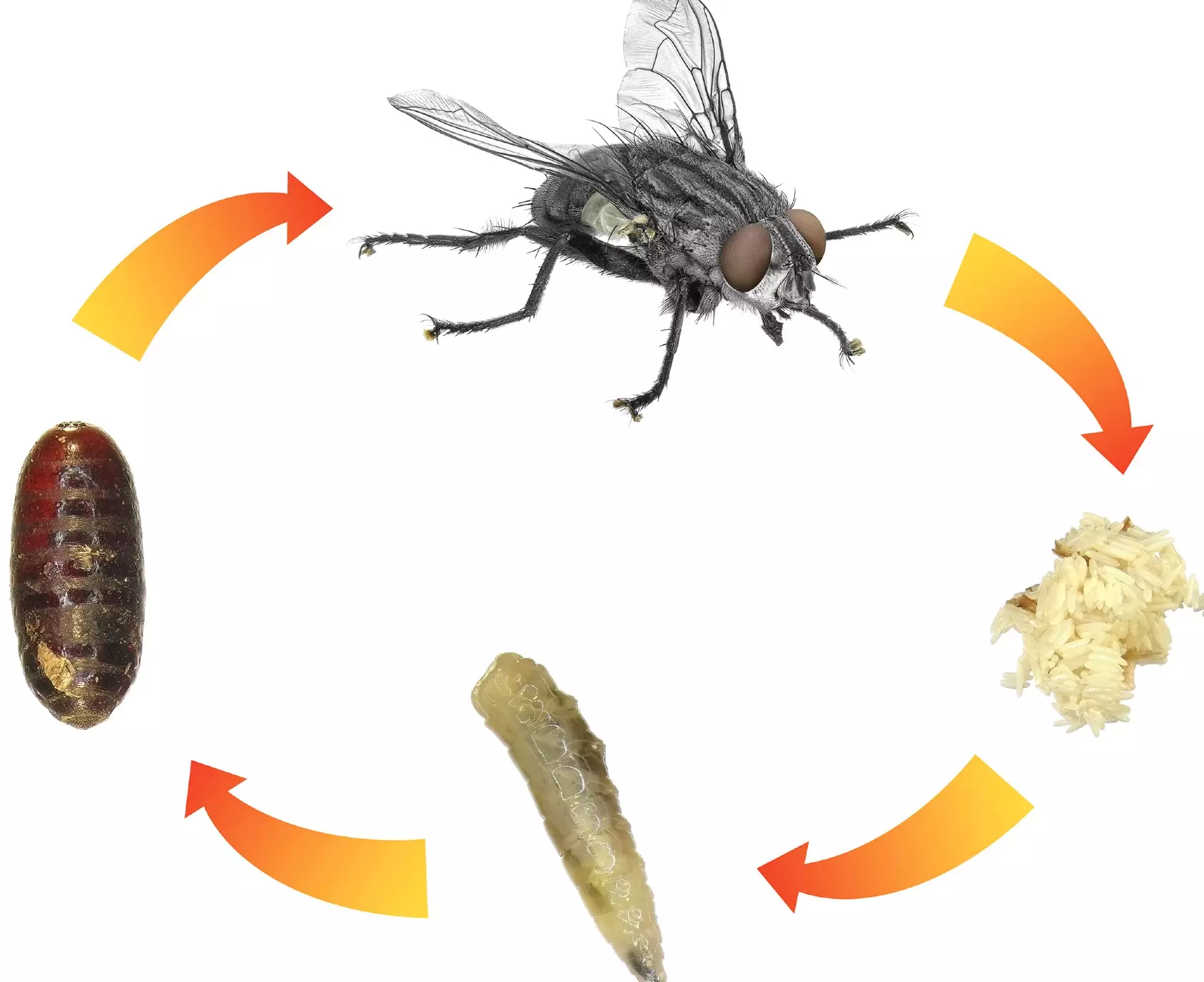
  • Four Life Stage Metamorphosis: All flies undergo complete metamorphosis: egg → larva (maggot) → pupa → adult. The larval stage is where all feeding and population growth occurs. Understanding which stage is present helps guide the suitable treatment because larvicide treatments at the breeding site are far more effective than killing adult flies which is the visible symptom of an active breeding source nearby.
  • Liquid Feeding and Pathogen Transfer: House flies cannot bite or chew. They feed by regurgitating digestive fluid onto food, dissolving it, then sucking up the liquid. Every feeding event deposits bacteria, viruses, and parasites from the fly's previous contact surfaces such as feces, garbage, carrion directly onto food. A single house fly can carry over 100 pathogens on its body and in its gut. This mechanical transfer is the primary public health concern associated with fly infestations.
  • Explosive Reproductive Potential: The House Fly's reproductive rate is among the fastest of any urban insect pest. On days with optimal summer conditions (30°C), a female fly lays 75–150 eggs that hatch in 12–24 hours with  larvae developing in 3–7 days. A new group of adult flies can emerge within 10 days of the egg being laid. A single female can theoretically produce hundreds of thousands of descendants in one season. This is why fly populations escalate so rapidly when a breeding source goes unaddressed.
  • Breeding Site Fidelity: Adult flies are highly mobile and may travel considerable distances from their breeding site for example House Flies can travel up to 3 kms. This means flies seen inside a building may have originated from a garbage area, a nearby restaurant dumpster, or an outdoor compost heap rather than an indoor source. Locating and eliminating the breeding site is a major step towards fly infestation prevention.
  • Temperature-Driven Activity: Fly activity is strongly temperature-dependent. House Fly populations peak between 20 to 35°C which are the average GTA summer temperatures. Extreme temperatures such as below 10°C and above 38°C will result in flies becoming sluggish and inactive. In heated commercial kitchens and food facilities, fly breeding and activity can continue year-round regardless of outdoor temperature.
  • Blow Fly and the Forensic Indicator: Blow Flies are the first insects to arrive at a deceased animal or human as quickly as within minutes in warm weather. If Blow Flies appear suddenly in large numbers inside a structure with no obvious seen food source, there could be potentially a deceased animal inside the wall void, attic, or crawl space. This could include rodents that died after consuming rodenticide creating a secondary pest problem requiring a different resolution approach.

Fly Diet, Breeding Sites & What Attracts Each Species

Understanding what attracts each fly species to a property is essential for both treatment and prevention. The following table identifies the primary attractants and breeding sources for each major species.
What Attracts Filth Flies (House & Blow) What Attracts Small Flies (Fruit & Drain)
Improperly sealed garbage and recycling bins Overripe or fermenting fruit left on counters
Compost bins without tight-fitting lids Slow or rarely used drains with organic biofilm
Animal feces in yard (dog waste, bird droppings) Empty wine, beer, juice, and soft drink bottles
Decaying meat, fish, or organic waste in bins Mop buckets and floor drains in commercial kitchens
Dead animals inside wall voids or attic spaces Damp soil in over-watered houseplants (fungus gnats)
Open floor drains in food service environments Fermenting residue under appliances and in cabinet corners
Uncovered food left out at room temperature Food debris accumulation in garbage disposal units

The Drain Fly Biofilm Problem: The drain fly breeds exclusively in the organic biofilm. Organic biofilm is a thick layer of bacteria, fungi, and decomposing material that coats the inside of slow or rarely used drain pipes. Pouring boiling water or bleach down a drain does not remove established biofilm and will not eliminate a drain fly infestation. Effective treatment requires physical removal of the biofilm using enzymatic drain cleaners or professional bio-foam treatments applied to all affected pipes. It is best practice to treat drains that are not used at least once a week for drain fly prevention.

Fly Reproduction & Life Cycle

Understanding what attracts each fly species to a property is essential for both treatment and prevention. The following table identifies the primary attractants and breeding sources for each major species.

  • Fly Eggs: House Fly females lay 75–150 eggs per batch directly on or within rotting food, feces, or decaying organic matter. Eggs are white, elongated, approximately 1 mm long, and hatch in 12–24 hours at 30°C. A female lays up to 6 batches in her lifetime producing up to 900 eggs total. Fruit Fly females lay eggs just below the surface of fermenting material.
  • Larval Stage (Maggots): Maggots are legless, cream-coloured, and feed voraciously in the breeding material (garbage, decaying organic matter, feces). House Fly larvae develop through 3 instars over 3–7 days. During this stage they are entirely contained within the breeding source and do not yet pose a direct human contact risk. Finding maggots in a garbage bin or food waste area confirms an active breeding source that must be eliminated immediately.
  • Pupal Stage: When fully developed, the larva stops feeding and hardens its outer skin into a dark brown barrel-shaped pupal case. This transformation occurs over 3-6 days emerging as an adult fly. Pupae are found in drier material adjacent to the breeding source such as soil near a compost bin, dry areas of a garbage room, or the edges of a drain. Pupae are resistant to most insecticides applied as surface sprays.
  • Adult Stage: Adult flies emerge with a single biological purpose: to mate and lay eggs. House Fly adults live 15–30 days. They begin laying eggs within 2–3 days of emergence. Adults are the life stage most visible to occupants but killing adult flies without addressing the breeding source is the equivalent of treating the smoke without extinguishing the fire. The breeding source elimination is the only intervention that resolves an infestation.

Image: Fly Life Cycle - Egg > Larvae > Pupae > Adult Fly

Fly Health Risks & Disease Transmission

Flies are among the most significant insect vectors of human disease globally. Their unique feeding behaviour splurging between feces, garbage, and food makes mechanical pathogen transfer inevitable wherever flies are present in significant numbers.

⚠  Salmonella and Food Poisoning — House Flies are a documented vector of Salmonella typhi, Salmonella typhimurium, and multiple other Salmonella serovars. They transfer bacteria from feces and decaying matter to food surfaces through feeding, regurgitation, and body contact. Fly-contaminated food is a well-established source of food poisoning outbreaks in both residential and food service settings.

⚠  E. coli and Gastroenteritis — Multiple E. coli strains including pathogenic O157:H7 have been isolated from house flies collected in urban environments. Flies foraging between dog feces or improperly managed compost and kitchen surfaces create a direct transmission route. This risk is significantly elevated in summer when fly populations peak and outdoor food preparation is common.

⚠  Myiasis — While rare in Canada, certain Blow Fly species can deposit eggs in open wounds, mucous membranes, or on sleeping individuals with poor hygiene. The resulting larval infestation of living tissue is called Myiasis. A more common equivalent in Ontario is the contamination of improperly stored pet food, garden vegetables, and stored meat by blow fly egg deposition highlighting why fly exclusion from food storage is critical.

⚠  Cholera, Typhoid and Dysentery (Mechanical Vectors) — House Flies are recognized mechanical vectors of cholera (Vibrio cholerae), typhoid (Salmonella typhi), and dysentery (Shigella dysenteriae). While these diseases are uncommon in Canada due to water infrastructure, fly control in food service environments is a regulatory requirement specifically because of their proven vector capacity for these pathogens.

⚠  Allergens and Asthma — Fly body fragments, dried larvae frass, and pupal casings become airborne in heavily infested environments. These particles are documented allergens capable of triggering rhinitis, asthma exacerbations, and skin reactions in allergy sensitive individuals.

⚠  Psychological and Business Impact — In food service, hospitality, and retail settings, a single visible fly can trigger negative reviews, social media complaints, and public health inspections. Toronto Public Health's DineSafe program treats fly infestations as a significant infraction. A failed DineSafe inspection for fly activity results in a public posting at the business, mandatory closure orders, and fines — in addition to the reputational damage of a visible posted notice.

Fly Activity Signs in Your Home or Business

Flies are visibility is an early indicator of a fly infestation  but understanding what each sign indicate helps determine whether the problem is a minor nuisance or an active breeding infestation requiring professional intervention.

✔  Persistent adult flies indoors — more than a few flies consistently present indoors despite closed windows is the clearest indicator of an indoor or nearby breeding source.
✔  Maggots in garbage, compost, or food waste — white legless larvae in organic waste confirm an active House Fly or Blow Fly breeding site that must be eliminated immediately.
✔  Dark spots on walls, ceilings, and light fixtures — small dark specks in clusters are fly fecal spotting indicating a regular roosting location near a breeding source.
✔  Small flies near drains or fruit bowl — Fruit Flies hovering near the kitchen sink, drain, or fruit bowl. Drain Flies resting on walls near floor drains and bathroom fixtures.
✔  Sudden appearance of large metallic flies — a sudden influx of Blow Flies with no obvious food source almost always indicates a dead animal inside a wall void, attic, or crawl space.
✔  Cluster of slow, sluggish flies on windows in winter — particularly on south-facing windows on mild days. Cluster Flies overwintering in wall voids emerging prematurely due to heat produced by the winter sun shine.
✔  Fly pupae (dark brown capsules) in dry areas near drains — barrel-shaped 4–6 mm dark brown cases near a drain or garbage area confirm an active breeding cycle that has reached the pupal stage.
✔  Moth-like insects near bathroom or floor drains — fuzzy-winged small (2–5 mm) insects resting on walls near drains or on moist surfaces are Drain Flies. Their presence confirms organic biofilm in the drain system.

Why Professional Treatment Is Essential

Fly infestations are one of the pest categories where the most common consumer response is using a fly swatter, fly strips, or spraying aerosol insecticide. This only addresses the visible symptom while the breeding source continues producing new adults at a faster rate than they can be killed.

- Killing adult flies without eliminating the breeding source is a permanent treadmill
— a female House Fly lays up to 900 eggs in her lifetime resulting in a fly population that will always outpace surface treatment.
- Drain Fly infestations require physical removal of drain biofilm — a process that requires enzymatic treatments and professional-grade bio-foam because DIY solutions such as bleach and boiling water do not penetrate established biofilm.
- Blow Fly infestations sourced from a dead animal inside a wall or attic require the animal to be located and removed — surface fly treatments without this step will continue indefinitely until the carcass is fully decomposed.
- Fruit Fly infestations often have multiple simultaneous breeding sources — drains, fruit bowls, improperly sealed recycling, and cabinet corners can all harbour active populations simultaneously. By missing any one source, fly populations are guaranteed to rebound.
- Commercial and food service fly infestations carry regulatory consequences under DineSafe and Ontario's Food Premises Regulation — professional documentation of treatment and corrective actions is required for compliance.
- Cluster Fly control requires exclusion of entry points in the building envelope — killing individual emerging flies does not address the population of thousands overwintering inside wall voids and attic spaces.

Keep Your Home/Business Pest-Free Today

Do you have a pest problem that needs to be looked at right away? Contact Guard More Pest Control about your pests and we'll work on solving your pest problem within 24 hours.

(647) 710-0481Contact Us
Guard More Pest Control
(647) 710-0481
contact@guardmorepests.com
93 Marjory Ave
Toronto, ON
M4M 2Y5
GoogleHomestarsNWCOABarkYelpTrustPilot
Pest Control ServicesCockroach Pest ControlBed Bug Pest ControlRodent (Mice/Rats) Pest ControlWildlife Pest ControlWasp Pest ControlSquirrel Pest ControlRaccoon Pest ControlPest NewsToronto Edition: 5 hardest pests to get rid of Preventation Tips to Avoid Pest Infestations2026/2025 Greater Toronto Area and Surrounding Areas Pest Report: News RecapWhat is Pest Control?What is the Difference between an Exterminator and Pest Control Professional?Winter Pests in the Greater Toronto AreaUniversity of California, Riverside Research Finds Bed Bugs Hate WaterRestaurant Pest ManagementCondo/Apartment Pest ManagementDetached/Semi-Detached House Pest ManagementCommercial Building Pest ManagementHotel Pest ManagementFall Pests in the Greater Toronto AreaHow to Hire a Pest Control in the Greater Toronto AreaBed Bug and Tick DifferencesSpring Pests in the Greater Toronto AreaSummer Pests in the Greater Toronto AreaToronto Mayor Declares War on "Bad Landlords" with New Enforcement Motion After Bed Bug, Mice, and Mould Complaints
Pest ProfilesBed BugsCockroachesRodents (Mice/Rats)RaccoonSquirrelWaspsBirdsAntsBeetlesFleasMothsFlies
Links
AboutPest Service PricesBed Bug ChecklistBed Bugs Post-Treatment GuideIntegrated Pest ManagementBed Bug Super Bug ResistanceWasp Seasonal Checklist Contact Us
Socials
FacebookXLinkedInYouTube
©2026 Guard More Pest Control Inc.
Privacy PolicyTerms of UseSitemap