.png)


Pest Profile: Wasps
Social wasps are stinging insects that live in organized colonies. They are commonly found near homes and businesses, and include specific species such as yellowjackets, paper wasps, and hornets. Social wasps do play an important role in controlling other insect populations, but they can become a safety concern when they build up in great numbers near areas where people live and work. This is because social wasps defend their nests aggressively, meaning disturbing a nest can lead to multiple stings.
Last Updated: August 30, 2026
Quick Facts about Wasps
Wasp Species Identification Guide
Identifying the correct species before treatment is critical. The nest location, colony size, aggression level, and treatment approach differ significantly between species.
✔ Yellow Jacket (Vespula spp.) — bright yellow and black banding; slender, hairless body. They are most commonly found nesting underground or in wall voids. Yellowjackets are scavengers that are attracted to outdoor food and drinks.They get aggressive when their nest is disturbed and responsible for stinging incidents across the GTA.
✔ Bald-Faced Hornet (Dolichovespula maculata) — black body with distinctive white/ivory face and tail markings. They builds large, teardrop-shaped aerial nests within trees, under eaves, and on structures. DO NOT approach Bald-Faced Hornets and their nests, they are highly aggressive defending aggressively from 3+ metres of the nest. Despite the name, they are a yellow jacket and not a true hornet.
✔ European Hornet (Vespa crabro) — largest stinging wasp in Ontario at up to 3.5 cm and brown, yellow, and black colouring. They nest in hollow trees, wall voids, and attic spaces conducting their activity during night (unique among social wasps). Lights attract the hornet at night. Their jaws are capable of chewing through wood to enlarge nest cavities.
✔ Paper Wasp (Polistes spp.) — slender, long-waisted body with brownish with yellow markings. They build small and open-cell umbrella-shaped nests under eaves, in porch ceilings, and on door frames. Compared to the other wasp species, Paper Wasps are less aggressive than yellow jackets unless directly disturbed. For gardens, they help rid them of caterpillars and other garden pests.
✔ Mud Dauber (Sceliphron spp.) — solitary and not colonial. They look long with a thread-like waist. Mud Daubers builds clay/mud tubes on walls, ceilings, and attic structures. They rarely sting (phew) and are beneficial for paralyzing spiders to provision nests. This insect is less urgent pest concern but mud tubes are cosmetically problematic.
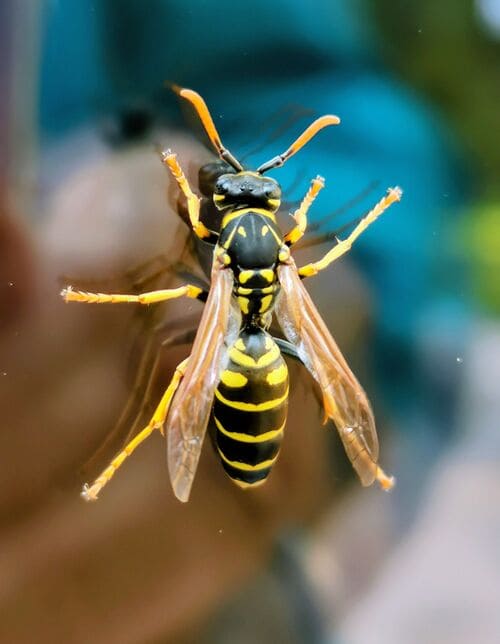
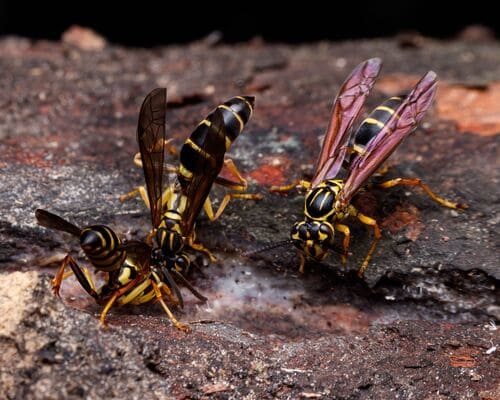
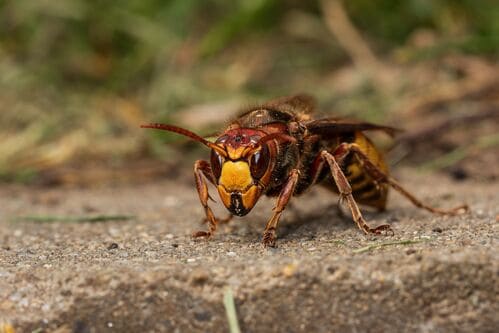
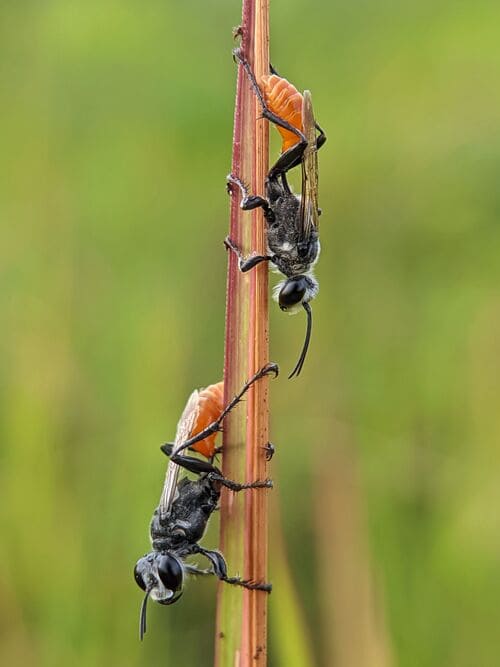
Yellow Jackets Are Not Bees: Yellow jackets are frequently mistaken for honey bees by homeowners leading to delayed treatment or incorrect removal attempts. Key differences: yellow jackets are hairless (bees are fuzzy), have a more defined waist, are more brightly yellow, and are significantly more aggressive. Yellow jackets do not produce honey and their nests must be treated and cannot be 'relocated' by a beekeeper. If you are unsure whether you have wasps or bees, contact us with a picture of the nest at contact@guardmorepests.com for a free assessment.
Wasp Colony Biology & Nest Development
Understanding the annual colony life cycle explains why wasp problems escalate so rapidly and why early-season treatment is far simpler than late-season intervention.
- [Spring] Queen Emergence (March–April): Only fertilized queens survive winter, overwintering in protected sites (under bark, in soil, in wall voids). In spring, a single queen emerges and begins building a small nest alone and raising the first cohort of workers entirely by herself. At this stage, the nest is golf-ball sized and the colony contains only 10–20 individuals so it is far easier and safer to address than a mature colony.
- [Early Summer] Colony Early Summer Establishment (May–June): The first workers take over foraging and nest expansion duties freeing the queen from the duties to focus solely on egg-laying. Colony size grows rapidly from dozens to hundreds. Nests grow from golf-ball size to fist-size. Aggression is relatively moderate during this phase while workers are focused on colony building.
- [Late Summer] Peak Colony & Maximum Aggression (July–September): Colony populations reach their peak with 1,500–10,000 workers depending on the species. The queen begins laying reproductive eggs (new queens and males). Workers become progressively more aggressive as the colony's defensive instinct intensifies. Natural food sources begin to decline driving yellow jackets to scavenge at outdoor dining areas, garbage, and fruit trees.
- [Fall] Colony Decline & Collapse (October–November): New queens and males leave the nest to mate. After mating, males die and new fertilized queens find overwintering sites. Workers, old queen, and the physical nest are abandoned and die with the first hard frosts. The same physical nest is NOT reused the following year but queens may return to the same vicinity to start a new nest.
- Nest Architecture: Wasp nests are built from chewed wood fibre mixed with saliva, producing a distinctive papery grey material. Nests consist of multiple horizontal tiers of hexagonal cells enclosed in a papery envelope. Yellow jacket underground nests can reach the size of a basketball or larger. Bald-faced hornet aerial nests routinely reach the size of a football. European hornets nest in wall voids and hollow trees making nest removal more complex.
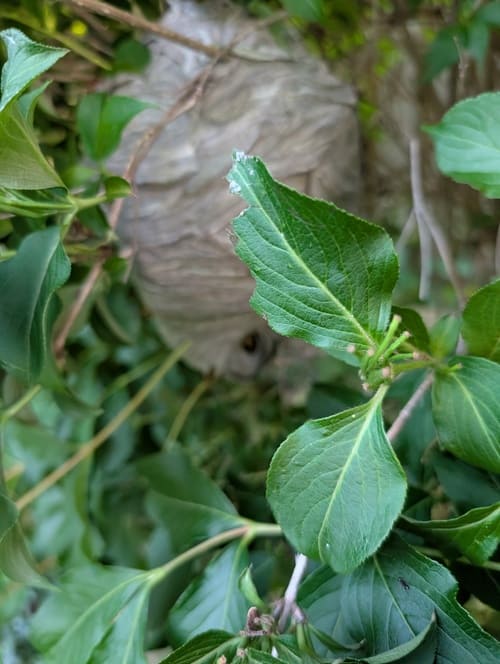
Image: Yellowjack Wasp Nest
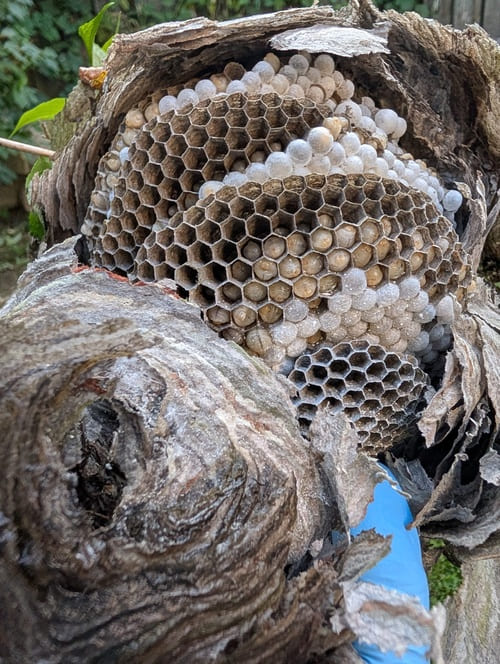
Image: Yellowjacket Wasp nest containing wasp larvae

Image: Yellowjacket Wasp nest build on attic wood beam
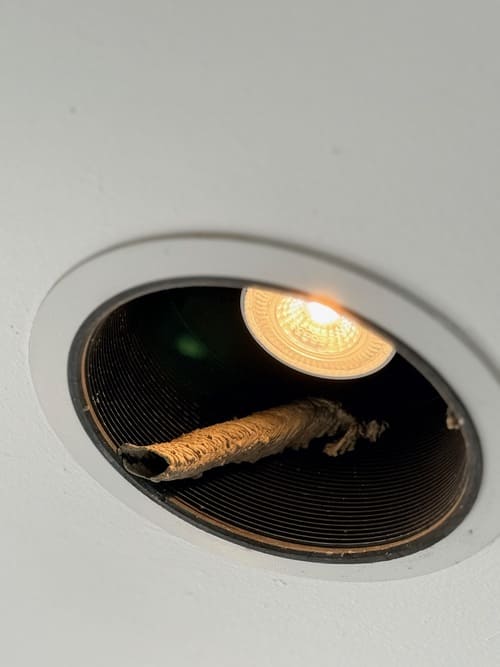
Image: Mud Dauber Wasp nest built in porch light
Wasp Nesting Locations on Your Property
Knowing where each species nests guides both detection and treatment approach. A nest location assessment is always the first step in our service.
Wasp Sting Risk & Medical Concerns
Wasp stings range from mildly painful to life-threatening. Understanding the range of reactions helps homeowners assess the urgency of professional removal.
⚠ Normal Sting Reaction — Most stings produce immediate and sharp pain followed by redness, swelling, and itching at the site lasting a few hours to 2 days. Multiple stings will intensify the reaction. Using ice, antihistamines, and hydrocortisone cream are ways to manage sting reactions. DO NOT squeeze the sting site as more venom could be squeezed into the affected area.
⚠ Large Local Reaction — Some individuals develop disproportionately large swelling at the sting site with significant swelling in an arm or leg spreading beyond the immediate sting area. This is an exaggerated local reaction, not anaphylaxis, but indicates sensitivity and increased risk of systemic reaction with future stings. Medical assessment is highly recommended.
⚠ Anaphylaxis — Life-Threatening Emergency — Approximately 1–3% of the population is allergic to wasp venom and can experience severe, whole-body allergic reaction known as anaphylactic shock. Symptoms include hives, throat swelling, breathing difficulty, rapid pulse, dizziness, and loss of consciousness. Anaphylaxis can be fatal within minutes. Anyone with a known venom allergy must carry epinephrine (EpiPen) at all times when outdoors.
⚠ Mass Envenomation — Disturbing a mature nest particularly underground yellow jacket nests can trigger a coordinated attack involving hundreds or thousands of wasps. Unlike honey bees, wasps can sting repeatedly. Mass envenomation (50+ stings) can be fatal even in non-allergic individuals due to venom toxicity. Never attempt to treat a suspected nest without professional equipment.
⚠ Children & Pet Risk — Children and pets are particularly vulnerable because they may disturb a ground nest without recognizing the danger. Children may not be able to retreat quickly enough and leashed pets cannot flee. Inspect play areas and yards in spring and early summer before allowing unsupervised outdoor activity in areas with vegetation, woodpiles, or soil.
Venom Allergy Testing: If you or a family member has experienced a severe reaction to a wasp sting, immunotherapy (venom desensitization) is available through an allergist and is up to 98% effective at preventing future anaphylactic reactions. Allergy testing is recommended for anyone with a history of large local reactions, previous anaphylaxis, or multiple stings causing systemic symptoms.
Signs of Wasp Activity on Your Property
The best time for early nest detection is in spring when nests are small. An early inspection can dramatically reduce treatment risk and cost. Watch for these signs throughout the warmer months:
✔ Visible nest structure — papery grey nest material in eaves, under overhangs, in trees, or on fences. The nest size can range from golf-ball to football size.
✔ Steady wasp traffic in and out of one point — multiple wasps entering and exiting the same hole in the ground, gap in soffit, or wall void opening repeatedly.
✔ Wasps inside the home — a significant number of wasps inside upper rooms indicates a nest in the attic, wall void, or soffit with a gap accessing the living space.
✔ Increased wasp presence near food and drink — late-season yellow jackets scavenging at outdoor meals, garbage cans, or fruit trees.
✔ Chewed wood appearance on wood surfaces — European hornets actively chew wood from fences, deck rails, and tree bark to build nest material. Look for rough, scraped wood surfaces near a suspected nest.
✔ Wasps congregating near lights at night — European hornets are nocturnal and attracted to porch lights and interior lights through windows.
✔ Buzzing sounds from walls or ceiling — a persistent buzzing or crackling sound from inside a wall or ceiling cavity indicates a large nest (potentially European hornets or yellow jackets) built inside the structure.
Why Professional Treatment Is Essential
Wasp nest removal is among the highest-risk DIY pest control attempts. The consequences of an incomplete or improper treatment can be immediate and severe:
- Wasp alarm pheromone: Disturbing a nest without killing the colony first triggers a mass defensive attack. The nest's alarm pheromone signals all workers to sting the threat simultaneously
- DIY Wasp sprays: Consumer wasp sprays have a limited range (3–5 metres) and do not penetrate underground nests, wall voids, or enclosed aerial nests. They will spray the entrance while the main colony remains active.
- Blocking entrances: Blocking the entrance to an underground or wall void nest without treatment forces the colony to chew through interior walls to find a new exit potential spilling into the living space
- Timing matters: treatment must be performed at night or very early morning when all workers are inside the nest and the colony is least active.
- Protective equipment: treating large or aggressive colonies safely requires a full bee suit, sealed gloves, and respiratory protection. The standard everyday clothing provides no meaningful protection.
- Underground nest size: Yellowjacket ground nests are often much larger than the entrance suggests. The underground nest size can range from the size of a basketball and larger sized nests are common making them completely invisible from the surface
Our licensed technicians identify the species and locate all nests, apply professional-grade insecticide directly to the nest interior (not just the entrance) using specialized injection equipment, treat aerial nests before physical removal to ensure the colony is neutralized, address wall void and underground nests with appropriate injection tools, remove accessible nest structures post-treatment, and seal entry points to prevent future colonies from establishing in the same location.
Related Wasp Articles
Keep Your Home/Business Pest-Free Today
Do you have a pest problem that needs to be looked at right away? Contact Guard More Pest Control about your pests and we'll work on solving your pest problem within 24 hours.