.png)


Pest Profile: Raccoons
Raccoons are clever, bold, and one of the most common urban nuisance wildlife species in North America. If they've found a way into your home, you need to act fast.
Last Updated: September 9, 2026
Quick Facts about Raccoons
Physical Identification of a Raccoon
The North American raccoon is one of the most recognizable wildlife species on the continent. Its distinctive appearance makes it easy to identify, even at a distance:
✔ Black facial mask — a bold black marking across the eyes and cheeks outlined in white like a mask.
✔ Ringed tail — alternating black and grey-brown bands with typically 5–7 rings and 20–40 cm (8–16 in) long in length.
✔ Grizzled grey-brown fur — coarse, dense coat with a salt-and-pepper appearance.
✔ Dexterous front paws — 5 slender, finger-like digits per paw. Raccoons can open garbage can lids, doorknobs, jars, and sliding doors.
✔ Stocky, hunched build — appears rounded and heavyset walking flat-footed (plantigrade stance) similar to bears.
✔ Pointed muzzle — relatively narrow snout with ears that are small, erect, and rounded at the tips.
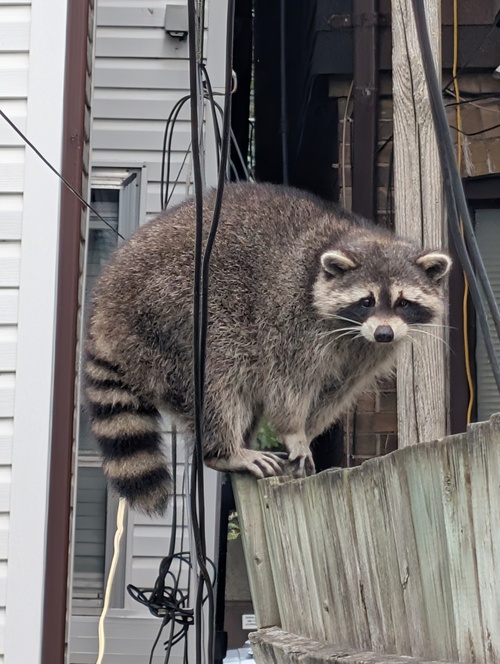
Image: Adult Raccoon walking on top of fence

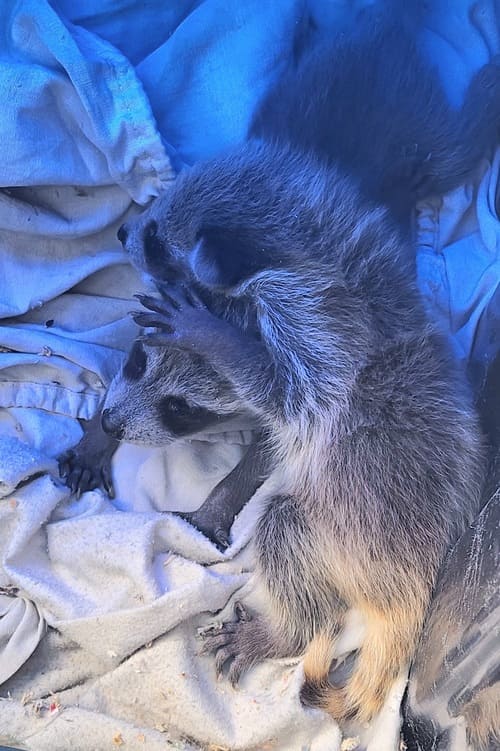
Image: Kits (Baby Raccoons)
Raccoon Behaviour & Biology
Raccoons are among the most adaptable and intelligent mammals in North America. Their behavioural flexibility is a key reason they thrive in urban and suburban environments.
- Nocturnal & Crepuscular Activity: Raccoons are most active between dusk and dawn. Daytime sightings are not uncommon but consistent daytime activity can indicate illness (including rabies), starvation, or a nursing mother. DO NOT approach a raccoon active in daylight.
- Highly Intelligence & Can Problem-Solve: Raccoons consistently rank among the most cognitively capable wild mammals and come close to the intelligence of a monkey according to a American Psychological Association (APA) article on Raccoon intelligence over the years. They remember solutions to tasks for up to 3 years, can open latches, jars, and trash can lids, and adapt quickly to new deterrents. This intelligence makes DIY exclusion challenging without professional help.
- Tactile Foraging (Dousing Behaviour): Raccoons have extraordinarily sensitive front paws with five digits. They often manipulate food near water, a behaviour once thought to be washing but now understood to be tactile exploration. This sensitivity allows them to find food in very dark environments.
- Den Site Selection: In the wild, raccoons use hollow trees, rock crevices, and ground burrows. In urban areas, they readily exploit attics, chimneys, crawl spaces, under decks, and wall voids as den sites — especially females seeking a safe location to raise kits.
- Winter Torpor (Not True Hibernation): Raccoons do not truly hibernate. In cold climates, they enter a state of deep sleep lasting weeks to months during severe cold with relying on fat reserves built up in the fall. They can lose up to 50% of their body weight over winter. They can wake and forage during warm spells.
- Social Structure: Raccoons are largely solitary outside the breeding season. Adult females may share territories and occasionally forage together. Adult males form loose male groups during non-breeding months. Kits stay with their mother for 8–12 months before dispersing.
- Baby Raccoon (Kit): A kit is born blind, deaf, toothless, and unable to regulate their body temperature for the first 3 months of their life. The inability to regulate body temperature is the reason why they are huddled up in corners and cramped spots.
Raccoon Diet & Foraging Habits
Raccoons are opportunistic omnivores and will eat almost anything available. Their diet changes with the seasons and varies dramatically between wild and urban habitats:
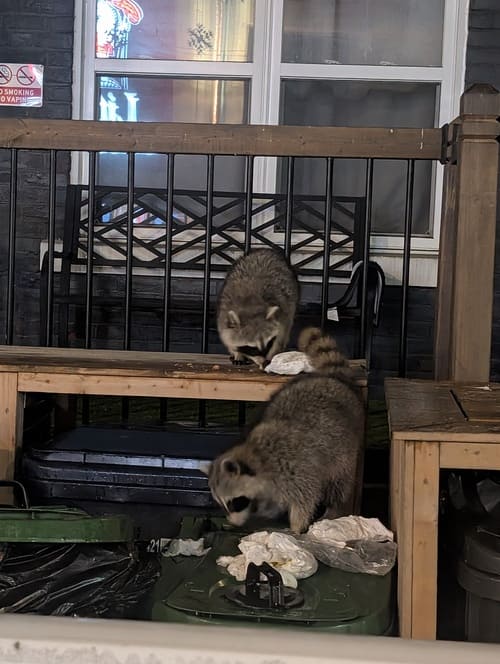
Urban Feeding Hazard: Raccoons that associate humans with food become bold, aggressive, and difficult to deter. DO NOT feed raccoons. Secure all garbage bins with bungee cords or locking lids, bring in pet food at night, and remove fallen fruit from yards. Feeding raccoons is illegal and subject to fines in many Ontario municipalities. Toronto Animal & Enforcement will fine you $365.00 if you are caught feeding wildlife. Learn more about what foods that are toxic to raccoons.
Raccoon Reproduction & Life Cycle
Understanding raccoon reproduction is critical for safe, humane, and effective removal especially in spring and early summer when females are living in a den with kits (baby raccoon).
- Breeding Season: Breeding season occurs January – March around the late winter. Males travel widely to find mates and may mate with multiple females. Females are receptive for only a few days. Dominant males do most of the breeding in a given area.
- Gestation: Females are pregnant for approximately 9 weeks (63-65 days). In the weeks before birth, the female selects a secure den site often an attic, chimney, or wall void in urban areas. She will aggressively defend this site. If you find a raccoon in your home, DO NOT go close to the raccoon.
- Birth: April - June is when the year's litters are born. Kits are born blind, deaf, and no teeth making them helpless. The mother nurses and protects them exclusively for the first 6–8 weeks. Kits begin to explore outside the den around 8–10 weeks and are weaned at 12–16 weeks.
- Independence: At 8–12 Months old, kits stay with their mother through the first summer and often through their first winter. They disperse in the following spring. Females often return to the same den site year after year.
- Sexual Maturity: approximately 1 year old females can breed in their first spring as young as 10 months. This rapid maturation contributes to the raccoon's high urban population density. A healthy female may raise 15 or more offspring in her lifetime.
Baby Season Protocol: If you suspect a raccoon has denned in your attic or chimney between April and August, DO NOT attempt removal without professional assessment. A female with kits will fight viciously if cornered. Separating kits from their mother creates a welfare and regulatory issue. Our technicians follow a specific baby-season protocol to ensure the entire family is safely and humanely relocated together.
Raccoon Habitat & Urban Range
The raccoon's greatest biological advantage is its adaptability. Originally a woodland-and-wetland species, it has colonized virtually every habitat type on the continent. Urban environments have caused raccoon populations to explode.
✔ Urban density 10–20x higher — Raccoon populations in cities like Toronto are estimated at 10 to 20 times the density found in rural areas
✔ Home range: 1–5 km in cities — Urban raccoons have much smaller home ranges than wild counterparts (which can exceed 50 km) due to abundant supply of food and shelter
✔ Highly territorial females — A female raccoon returns to the same den site year after year. This means that if she denned in your attic last spring, she will attempt to return to the same attic
✔ Canada's raccoon capital — Toronto is widely regarded as having one of the highest urban raccoon densities of any city in the world with estimates of 23+ raccoons per square kilometre in some neighbourhoods.
Toronto introduced raccoon-resistant 'green bins' in 2016 after raccoons defeated the original design within weeks. The city has since invested millions in raccoon management. Urban raccoons in Toronto have adapted so completely to city life that wildlife researchers study them as a primary model for urban wildlife adaptation worldwide.
Property Damage Raccoons Cause
Raccoons are among the most destructive wildlife pests in urban and suburban settings. The damage they cause goes well can be structurally significant and expensive to repair.
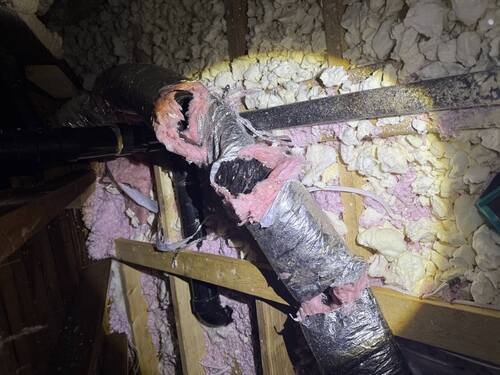
- Attic Damage: Raccoons tear through roof vents, fascia boards, soffits, and shingles to access attics. Once inside your home, they destroy insulation (flattening and soiling it), chew wiring (serious fire hazard), and contaminate the entire space (urine and feces). Remediation of a heavily used raccoon attic can cost $3,000–$15,000+.
- Electrical Fire Risk: Raccoons gnaw on electrical wiring throughout attics and wall voids. Damaged wiring is a leading cause of residential electrical fires. This hazard can go undetected for months. Any property with confirmed raccoon activity should have wiring inspected by an electrician.
- Latrine Sites & Fecal Contamination: Raccoons establish communal latrine sites and often return to the same location repeatedly. Attics, decks, rooftops, and sandboxes are common latrine sites. Accumulated feces (called a 'midden') can cause structural rot and releases ammonia that permeates building materials. The cleanup of raccoon aftermath requires specialist handling.
- Yard & Garden Damage: Raccoons dig up lawns searching for grubs (especially after rainfall), raid vegetable gardens and fruit trees, knock over garbage bins, and well groomed gardens. A single raccoon can destroy a lawn or garden bed in one night.
- Pool & Deck Contamination: Raccoons defecate in and around swimming pools, hot tubs, and water features. Raccoon feces in water poses a direct health hazard. They can also damage pool covers and screen enclosures trying to access the water.
Raccoon Health Risks & Disease Transmission
Raccoons pose several direct and indirect health risks to humans and pets. These risks are serious and should inform how any raccoon encounter or infestation is handled.
⚠ Rabies — Raccoons are the most common carrier of rabies in North America. Any raccoon behaving erratically, appearing disoriented, or active in the daytime should be treated as potentially rabid. DO NOT approach a raccoon during daytime. Contact animal control or a licensed wildlife removal professional immediately.
⚠ Raccoon Roundworm (Baylisascaris procyonis) — This intestinal parasite is shed in raccoon feces. Microscopic eggs can survive in soil and on surfaces for years. Accidental ingestion (especially by children) can cause severe neurological damage or death. Latrine sites must be cleaned by professionals in full PPE and never with bare hands.
⚠ Leptospirosis — A bacterial infection spread through raccoon urine that can contaminate water, soil, and surfaces. Humans and pets can be infected through skin contact or ingestion. It can cause kidney and liver failure if left untreated. Particularly concerning around flooded areas or standing water.
⚠ Distemper — Canine distemper is common in raccoon populations and is fatal to raccoons but the virus can infect unvaccinated dogs. Distemper causes raccoons to stagger and appear confused which can be mistaken for rabies. Ensure all pets are vaccinated.
⚠ Giardia — A parasitic protozoan found in raccoon feces that contaminates water sources and soil. It causes gastrointestinal illness in humans and pets. A major concern around properties with water features, streams, or flooded yards.
⚠ Fleas, Ticks & Mites — Raccoons carry and introduce fleas, ticks, and mange mites into attics, crawl spaces, and around den sites. Once raccoons are removed, the parasites they leave behind will seek new hosts often entering the living space of the home.
DO NOT Handle Raccoons: You should never attempt to handle, trap, or relocate a raccoon without professional training and proper equipment. Even a healthy raccoon can inflict a severe bite. All raccoon bites require immediate medical evaluation and potential rabies prophylaxis treatment. Under Ontario's Fish and Wildlife Conservation Act, it is also illegal for the public to trap and relocate raccoons beyond 1 km from the capture site.
Signs of Raccoon Activity on Your Property
Early detection is key to minimizing damage and simplifying the animal's removal. Watch for these warning signs:
✔ Thumping or heavy scratching in attic — Raccoons are large and noisy especially at dusk or dawn.
✔ Torn or displaced roof vents or soffits — Look for pulled-back metal, torn screens, or displaced fascia boards on the roofline.
✔ Tracks on roof or around the foundation — Raccoons leave five-fingered hand-like prints approximately 5 cm wide.
✔ Latrines on the roof or deck — See piles of dark tubular feces (3–5 cm long) concentrated in one area in places such as a corner of the deck, a flat roof section, or near the chimney.
✔ Knocked-over garbage bins — Find garbage bins that are on its side and/or evidence of rummaging in compost or recycling.
✔ Dug-up lawn patches — View cone-shaped holes or rolled-back turf sections where raccoons excavated grubs.
✔ Distinctive odour — Smell strong ammonia/musty from urine seeping through attic floor/ceiling, near chimney, and/or vents.
✔ Pet food disappearing overnight — If any pet food is left outside, raccoons will visit nightly and return with others.
✔ Deck or shed access points — Observe disturbed soil, scratch marks, or pushed materials near the base of decks, sheds, or porch areas.
Why Professional Removal Is Essential
Raccoon removal might seem straightforward but multiple factors make it far more complex and legally regulated than most wildlife removal:
✔ Legal restrictions: under Ontario's Fish and Wildlife Conservation Act, it is illegal to trap a raccoon and release it more than 1 km from the capture site without a permit.
✔ Baby season risk: removing a female in spring without locating and removing her kits results in kits dying inside the structure — causing odour, secondary pest infestations, and structural issues.
✔ Disease exposure: The handling raccoons or their feces without proper PPE puts you at risk of rabies, roundworm, leptospirosis, and other harmful pathogens.
✔ Ineffective without exclusion: The trapping alone is not enough, new raccoons will occupy any unsealed entry point within days. Permanent resolution requires structural exclusion.
✔ Aggression: Cornered raccoons bite and scratch viciously particularly females protecting kits. Even a healthy bite requires medical evaluation.
✔ Re-entry: Raccoons have a strong homing instinct and may return from several kilometres away if released too close to the original den site.
Our licensed technicians conduct a full property inspection, identify all entry points and the presence of young, deploy humane one-way exclusion devices or live traps, remove and relocate the entire family, seal every entry point with raccoon-proof materials, and follow up to verify successful raccoon exclusion. Everything performed all in compliance with Ontario wildlife regulations.
Related Raccoon Articles
Keep Your Home/Business Pest-Free Today
Do you have a pest problem that needs to be looked at right away? Contact Guard More Pest Control about your pests and we'll work on solving your pest problem within 24 hours.