.png)

WILDLIFE CONTROL SERVICES - RACCOON REMOVAL & EXCLUSION
Raccoons are one of the most common and most costly wildlife problems facing GTA homeowners. Toronto has one of the highest urban raccoon densities in the world estimated at over 100,000 raccoons across the city. The problem is more prevalent in established residential neighbourhoods where mature trees, older housing stock, and abundant food sources create ideal conditions for raccoon habituation. As trained wildlife control operators, Guard More Pest Control delivers best-in-class animal removal and exclusion giving back homeowners a peace of mind.
Humane removal · Structural exclusion · Lifetime guarantee on coverings · Working at Heights certificated technicians
Last Updated: August 8, 2026


Once a raccoon establishes a den in your attic, chimney, or soffit, it will return to the same site year after year. Females raise their litters there in spring and use it as a winter den site in fall. Without professional removal and permanent structural exclusion, the raccoon problem compounds season over season. Guard More Pest Control provides humane raccoon removal and professional-grade exclusion across the GTA backed by a lifetime guarantee* on all coverings installed. *coverings installed must not be modified or removed by humans.
Licensed & Compliant with Ontario Wildlife Regulations: In Ontario, raccoons considered 'farmed animal' and are regulated under the Fish and Wildlife Conservation Act (FWCA). It is illegal to trap a raccoon and release it more than 1 kilometre from the capture site without a permit. Guard More Pest Control operates in full compliance with all applicable Ontario and municipal wildlife regulations. Our removal methods are humane, legal, and documented.
Note: A 'farmed animal' covers species prescribed by the regulations that is being kept in captivity in Ontario for the purpose of commercial propagation or the commercial production of meat, hides, pelts, antler products or other products.
Why Raccoons Choose Your Home
Raccoons are not entering your attic by accident. They are highly intelligent animals that actively assess and exploit structural vulnerabilities in buildings. Three factors drive raccoon intrusion in the GTA:
- Warmth and shelter — GTA raccoons seek secure den sites for raising litters (April–August) and for winter denning (October–March). Attics provide the ideal combination of warmth, darkness, and protection from predators.
- Food availability — Toronto's raccoons are experienced foragers with five dexterous digits per paw allowing them to open and exploit garbage bins, compost, outdoor pet food, fruit trees, and bird feeders. Properties with accessible food sources experience significantly higher raccoon pressure.
- Site fidelity — Raccoons return to the same den site year after year. A female that denned in your attic last spring will attempt to return the following year and will bring her nearby offspring. Without permanent home exclusion, the raccoon population pressure on your property increases each season.
Common Raccoon Entry Points in GTA Homes
Raccoons are strong, dexterous animals capable of tearing through compromised building materials. These are the most common entry points our technicians find in Toronto-area properties:
Soffits & Fascia
The rotted or loose soffit panels are the #1 raccoon entry point in Toronto's older housing stock.
Roof Vents
Standard aluminum vent screens are easily torn open as raccoons regularly target them directly as attic access points.
Roof-Wall Junctions
The junction where the lower roof meets a vertical wall creates a natural gap that raccoons exploit with leverage.
Chimneys
All uncapped or damaged chimneys are a primary raccoon entry especially in old homes built before the 1980s in Toronto.
Rotted Wood
Any moisture-damaged fascia boards and roof deck sections are soft enough for raccoons to tear open with their paws.
Plumbing Stacks
The flashing around plumbing stack penetrations on the roof is frequently loose or improperly sealed.
The Toronto Neighbourhood Risk Factor: Properties within Annex, Riverdale, Cabbagetown, Roncesvalles, High Park, and other established Toronto neighbourhoods with mature tree canopy are at significantly higher risk for raccoons. A tree branch within 3 metres of your roof can act as a bridge for raccoons to reach rooflines so trimming them is one of the most important preventive steps for properties in these neighbourhoods. Guard More can advise on branch clearance requirements as part of every inspection.
Our Step-by-Step Raccoon Removal Process
Guard More Pest Control follows a structured, humane removal and exclusion protocol on every job. We do not cut corners on the inspection or the exclusion work because we know an incomplete removal and incomplete exclusion are the two reasons most raccoon jobs fail allowing the raccoon to return on your property.
- Full Property Inspection: Our licensed technician conducts a complete interior and exterior inspection of roofline, attic, soffits, fascia, chimney cap, all vents, as well as the full perimeter of the structure. We identify all active and potential entry points, assess evidence of nesting and occupancy (droppings, insulation damage, urine staining), and [super critical] to determine whether young (kits) are present before any removal work begins.
- Baby Season Assessment (April – August): If inspection reveals that a female with kits is present, we follow Ontario's baby season protocol. We locate the kits, place them in a warm box at the entry point, and allow the mother to relocate her family voluntarily to an alternative den site over the next 24–48 hours. This approach is both the most humane and the most legally compliant method and it prevents kits from dying inside the structure which will create worse remediation problems.
- One-Way Exclusion Door Installation: We install a one-way exclusion door at the primary active entry point. This device allows the raccoon to exit the structure at its normal departure time (dusk) but prevents re-entry. The one-way door remains in place for a minimum of 3–5 days and longer if weather prevents normal raccoon activity to confirm all animals have exited.
- Confirmation and Secondary Entry Sealing: Once we confirm the structure is clear, we remove the one-way door and permanently seal the primary entry point. All secondary entry points and vulnerabilities identified during the initial inspection are sealed at this stage using the appropriate exclusion materials for each location. We do not leave any gap unsealed.
- Attic Assessment & Remediation Guidance: After exclusion is complete, we assess the attic for the extent of insulation contamination, structural damage, and fecal matter accumulation. We provide a written report covering the findings and advise on professional attic remediation. Raccoon feces contain Baylisascaris procyonis (raccoon roundworm) which is a serious human health hazard that requires specialist cleanup protocols.
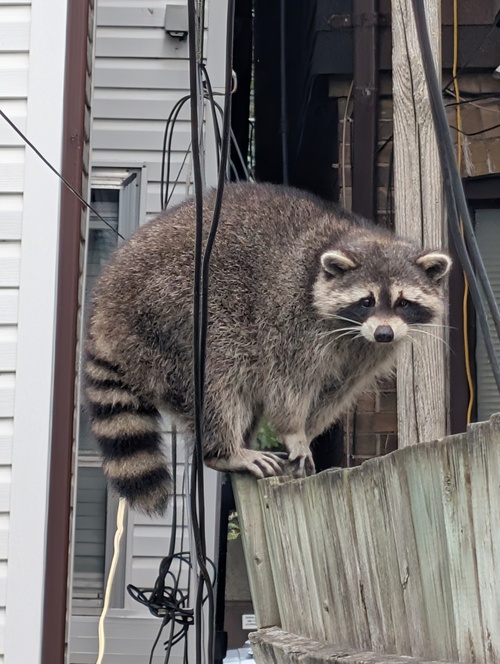
Image: Adult Raccoon walking on wooden fence

Image: Kits (baby raccoons) are blind, deaf, and have no teeth for the first 3-6 weeks of their life.
Why We Never Skip the Baby Assessment: Skipping the baby assessment and proceeding directly to exclusion is the single most common mistake in raccoon removal creating the worst possible outcome. A mother separated from her kits will tear through exclusion materials, damage adjacent building components, and cause thousands of dollars in additional structural damage in her attempts to re-access her young. Kits sealed inside the structure will die and their bodies will produce an extreme odour problem leading to a secondary fly and beetle infestation. Our technicians will not proceed with exclusion until we have confirmed the status of any young.
What and Why We Install Exclusions
Exclusion is the permanent solution with any wildlife. Removal without exclusion is a temporary fix because a new raccoon will occupy an unsecured opening within days. Guard More installs professional-grade exclusion materials (24 guage steel) rated for raccoon strength and GTA weather conditions, and backs every installation with a lifetime guarantee* on all coverings. *coverings installed must not be modified or removed by humans.
*Lifetime guarantee is valid provided coverings are not removed or modified by human activity. Guard More Pest Control stands behind every installation for the life of the structure.
Why Standard Materials Fail: Hardware store bought aluminium mesh screens, foam sealants, and standard caulk are not adequate raccoon exclusion materials. Raccoons exert significant force and can tear aluminium mesh open and remove standard foam within minutes. All Guard More exclusion materials are specified for wildlife resistance: minimum 24-gauge galvanized steel mesh for screens, minimum 20-gauge galvanized steel for flashing panels, and no foam sealant as a standalone seal at any raccoon-risk location.
Raccoon Removal & Exclusion Costs in the GTA
Raccoon removal and exclusion pricing depends on four factors: the size and complexity of the property, the number and accessibility of entry points, whether young are present (requiring the baby season protocol), and the extent of exclusion work required. The following table reflects typical GTA market pricing ranges for 2025–2026.
Get a Written Quote Before Any Work Begins: Raccoon removal pricing varies significantly between GTA companies. Be cautious of unusually low initial quotes that exclude the exclusion work because removal of the animal without exclusion installation is a short-term fix that will require repeat service. Ask any company you contact for an itemized written quote that clearly identifies what is included in the removal service and what exclusion work is proposed at what cost. Guard More provides itemized written quotes on every job.
What happens when parents don't come back for their raccoon baby or babies?
We surrender the animals to a wildlife partner, Toronto Wildlife Centre, that takes in animals and rehabilitate the orphaned animals. You can see all IDs of that animals that Guard More Pest Control surrenders to Toronto Wildlife Centre at https://www.guardmorepests.com/humane-wildlife-surrendering
We send the same IDs to the client's serviced property where we removed the surrendered animal(s) from.
Related Raccoon Articles
Related Wildlife Management Services
Keep Your Home/Business Pest-Free Today
Do you have a pest problem that needs to be looked at right away? Contact Guard More Pest Control about your pests and we'll work on solving your pest problem within 24 hours.