.png)


Pest Profile: Boxelder Bugs
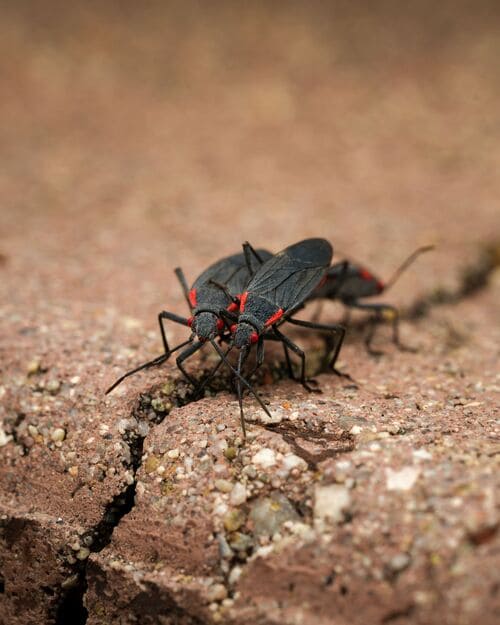
Boxelder Bugs have a very distinctive look to them with the red-orange striped pronotum (shield-like back plate). Boxelder Bugs live in the common Manitoba maple tree in big numbers. Learn more about this annoying yet unique looking insect.
Last Updated: July 31, 2026
Quick Facts about Boxelder Bugs
Physical Identification of Boxelder Bugs
Boxelder Bugs are among the most visually distinctive insects encountered by Ontario homeowners. Their bold black-and-red colouring makes them unmistakable once you know what to look for. Though first encounters often cause alarm disproportionate to the actual threat they pose.
✔ Adult colouring — black body with three red-orange stripes on the pronotum (shield-like plate), red-orange diagonal lines along the outer edges of the wings, and a red-orange border running along the wing margin.
✔ Bright red abdomen — lifting the folded wings reveals a bright red-orange abdomen beneath which is one of the clearest and most consistent field identification features of a Boxelder Bug adult.
✔ Flattened, elongated-oval body — adults are approximately 12–14 mm long, flat, and oval-elongated. This form is the classic "true bug" body form of the order Hemiptera; they hold their wings flat over the abdomen when at rest.
✔ Nymphs (brilliantly red coloured) — newly hatched first-instar nymphs are almost entirely brilliant red with only small dark wing pads visible; they darken progressively through five instar stages and developing the adult black markings as they mature; early instars are frequently mistaken for a completely different species.
✔ Six legs and functional wings — adults have fully developed wings and are capable of flight, though they are not strong or fast fliers; the majority of movement is by walking.
✔ Shield-like pronotum - the back plate immediately behind the head is distinctly wider than the head and bears three characteristic red stripes; this feature distinguishes Boisea trivittata from similar-looking native Ontario bugs.
Insect Terminology
Instar is a developmental stage of an arthropod (like an insect or spider) that occurs between each molt (shedding of skin, feathers, fur, or shells) until it reaches sexual maturity.
Most Common Misidentification: Boxelder Bugs nymphs at their first and second-instar phase are bright red and small, and are frequently mistaken for red spider mites, tiny beetles, or even bed bugs by homeowners who encounter them indoors. Key distinguishing features: Boxelder Bug nymphs are significantly larger than mites (3–7 mm versus under 1 mm), have six legs rather than eight (mites are arachnids), and have the elongated true-bug body form. Boxelder nymphs DO NOT bite.
Boxelder Bugs Behaviour & Biology
Boxelder Bug behaviour follows a highly predictable seasonal cycle driven by temperature and daily duration of sunlight. Understanding this cycle is the key to understanding both why they appear in such large numbers and why they emerge inside buildings during winter and early spring when GTA homeowners believe the problem has resolved.
- Spring & Summer: As temperatures rise above 10°C in May and June, the overwintered adults move to Manitoba maple and silver maple trees to feed, mate, and reproduce. Eggs are laid on host tree seeds, leaves, and bark. Nymphs develop through five instars over the summer months with adults fully mature by July–August. During this phase, Boxelder Bugs are rarely noticed because they are usually dispersed across host trees and surrounding vegetation.
- Fall: As temperatures drop in September and October, Boxelder Bug adults undergo a dramatic behavioural shift. They congregate in enormous numbers on warm, sun-exposed building surfaces usually the south- and west-facing brick, siding, and window frames of the nearest structures. Populations of hundreds to thousands may accumulate on a single wall face within days. This congregation behaviour is triggered by the search for overwintering sites rather than any attraction to the building itself.
- Winter: Boxelder Bugs enter buildings through gaps in the building envelope and aggregate in large numbers inside wall voids, attic spaces, and window frame cavities. Once inside, they become dormant and are entirely invisible to occupants. They do not feed, reproduce, breed, cause structural damage, or contaminate food while overwintering. They wait for spring temperatures to return.
- Premature Emergence on Warm Winter Days: The most disruptive indoor phase occurs on warm winter days. This disruption occurs during the January or February thaw common in southern Ontario. Solar heat warms the wall surfaces where the bugs are sheltering which causes them to become active and move toward light. They appear on window sills, ceiling light fixtures, and interior walls in significant numbers. Every individual seen indoors in January has been inside the wall since the previous October.
- Spring Departure: As outdoor temperatures consistently warm in April and May, the overwintering Boxelder Bugs reverse course and move back outdoors toward their host trees, exiting through the same gaps they entered the previous fall. Homeowners often note a surge of activity in spring as bugs emerge from walls and windows on their way out. Without addressing the entry points, the same cycle repeats the following fall as the local populations grow larger as successive generations add to the pressure.
What Attracts Boxelder Bugs to Your Property
The single most important factor determining Boxelder Bug pressure is proximity to female Manitoba maple trees. Properties without a suitable host tree nearby are at minimal risk regardless of all other factors.
The Manitoba Maple Factor in Ontario: Manitoba Maple (Acer negundo) is the primary Boxelder Bug host, and is one of the most common street trees in southern Ontario. It was planted extensively across post-war GTA neighbourhoods in Toronto, Etobicoke, Scarborough, North York, Mississauga, Brampton, and across the region for its fast growth and cold hardiness. As these trees have matured, they produce large quantities of seed each year sustaining Boxelder Bug populations as it is their primary food source. Even properties without a Manitoba maple on the lot experience fall aggregation from populations breeding in street trees and neighbouring properties. Boxelder Bug pressure is essentially ubiquitous in established GTA residential neighbourhoods.
Property and Health Impacts of Boxelder Bugs
Boxelder Bugs are frequently misunderstood because their appearance (large numbers, bold red colouring, sudden emergence) suggests a threat that does not actually exist. Understanding what they do and do not cause is essential for setting realistic expectations.
- What Boxelder Bugs DO NOT Cause: Boxelder Bugs DO NOT bite or sting humans or pets under any circumstances. They do not carry or transmit any disease. They do not damage wood, insulation, wiring, drywall, clothing, food, or any structural or household component. They do not breed indoors. They do not feed indoors. A Boxelder Bug infestation is visually dramatic and considered a nuisance problem but does not cause health, safety, or structural problems of any kind.
- What Boxelder Bugs Do Cause: Their primary tangible impact is staining. When disturbed, handled, or crushed, the Boxelder Bugs release a red-orange pigment from scent glands that stains fabric, curtains, upholstery, and painted surfaces. This red-orange pigment is extremely difficult to remove from porous materials once it sets in. Large indoor populations produce a distinct, mild but persistent odour. Their fecal spotting look like small reddish-brown dots which accumulate on window sills, walls, and surfaces near aggregation sites and light fixtures.
- Never Crush Boxelder Bugs on Fabric, Curtains, or Upholstered Furniture: The most common and most costly homeowner mistake is crushing Boxelder Bugs on particularly on windowsill curtains, upholstered furniture, or carpet. The pigment released is a persistent red-orange stain that is extremely difficult to fully remove from natural fibres and porous surfaces. It will not wash out in a standard laundry cycle. Always use a vacuum with a hose attachment to suck them up or sweep them into soapy water. DO NOT crush them directly.
Signs of Boxelder Bug Activity
- Large aggregations on south or west facing walls in fall — hundreds to thousands of black-and-red insects on sun-exposed brick, siding, or window frames in September and October. The gathering number of boxelder bugs can cover an entire wall face.
- Red-orange staining on siding, window frames, or masonry — red-orange pigment deposits from scent glands accumulate on surfaces where bugs regularly congregate; the staining will worsen over successive seasons on structures with recurring infestations.
- Insects appearing on interior window sills in winter — particularly on warm days from January through March; these are overwintering bugs emerging prematurely from inside the wall void and are not considered new arrivals from outside.
- Slow, sluggish movement on south-facing windows and interior walls — disoriented overwintering bugs are characteristically slow and clumsy when prematurely active in winter; they crawl rather than fly and gravitate toward window glass and light fixtures.
- Bright red nymphs on host trees in June and July — small, intensely red insects on Manitoba maple or silver maple seeds, leaves, and bark in early summer. The summer generation will become the fall-congregating adults.
- Fecal spotting on window frames, sills, and walls near light sources — small reddish-brown spots accumulating around windows and ceiling light fixtures near the primary congregation or entry sites.
It is important for GTA homeowners to understand that Boxelder Bug management is an annual process of reduction rather than permanent elimination. So long as female Manitoba maple trees exist within foraging distance of the property, some level of fall congregation and building entry attempt is essentially inevitable. The goal of a professional pest management program is to minimize the number that successfully enter the structure each year through consistent exclusion and targeted outdoor treatment.
Our licensed technicians will locate the infestation, apply the appropriate chemical treatment in-doors, and perform a residual perimeter treatment to keep you protected from future boxelder bug problems.
Keep Your Home/Business Pest-Free Today
Do you have a pest problem that needs to be looked at right away? Contact Guard More Pest Control about your pests and we'll work on solving your pest problem within 24 hours.