.png)

Hantavirus 101 and Recent News Coverage
Cruiseship Hantavirus Outbreak: 1 tested Positive in British Columbia and total 10 Canadians isolating and observed (45 days) for symptoms.
Last updated:
July 15, 2026

Cruiseship Hantavirus Outbreak: 1 tested Positive in British Columbia and total 10 Canadians isolating and observed (45 days) for symptoms.
Disclaimer: Guard More Pest Control Inc. and the article's author are not licensed medical healthcare professionals. We are writers gathering information about the topic that has been in the news lately and work on being as accurate as possible on the topic.
A deadly hantavirus outbreak aboard the Dutch expedition cruise ship MV Hondius has killed three passengers and infected at least five others, prompting an unprecedented multinational evacuation operation as the vessel approaches Tenerife in Spain's Canary Islands. The outbreak caused by the South American Andes virus (ANDV), the only hantavirus strain known to spread between people. While the World Health Organization and the U.S. Centers for Disease Control and Prevention both stress the risk to the general public is low, the incident is the first hantavirus outbreak ever recorded on a cruise ship and a stark reminder that a pathogen long associated with dusty cabins and grain sheds can travel as easily as its passengers.

The MV Hondius, a 196-passenger Dutch-flagged expedition vessel operated by Oceanwide Expeditions, departed Ushuaia, Argentina on April 1, 2026 for an Antarctic and South Atlantic voyage that was scheduled to end in the Canary Islands. By April 6, a 70-year-old Dutch passenger had developed fever, headache and diarrhea. He died on April 11 and was initially recorded as a natural-causes death with no microbiological testing performed by the ship's single physician.
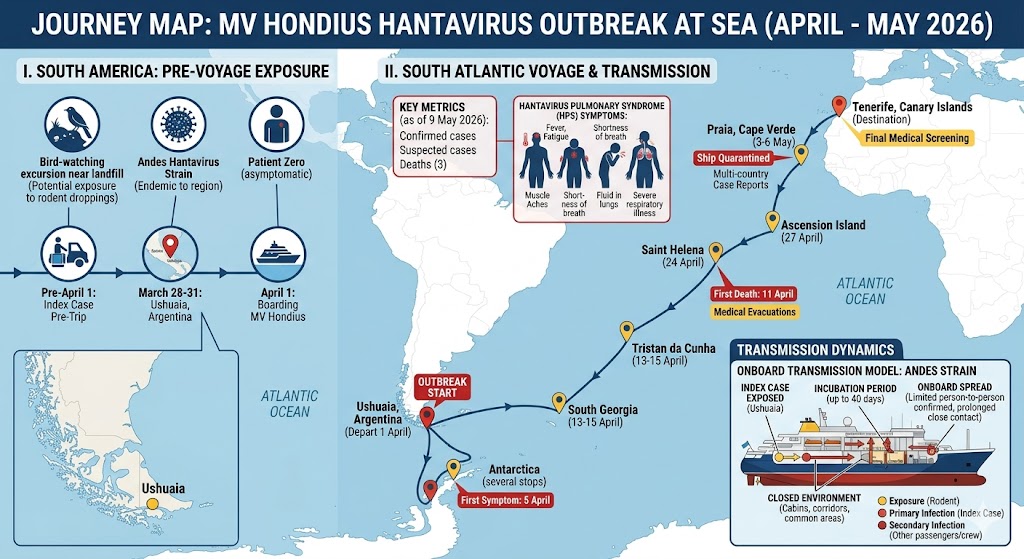
After the ship called at Saint Helena on April 24, roughly 30 passengers disembarked including the deceased man's symptomatic 69-year-old widow. She boarded a KLM flight from Johannesburg the next day, deteriorated en route, and died on April 26. A British passenger medically evacuated from Ascension Island the following day was the first to receive a definitive diagnosis: PCR testing at South Africa's National Institute for Communicable Diseases confirmed hantavirus on May 2, 2026, the same day a German passenger died on board. The WHO confirmed the strain as Andes virus on May 6 with sequencing data from a Swiss patient publicly posted the next day.
As of May 8, the WHO tally stood at eight cases (six laboratory-confirmed and two suspected) with three deaths. Confirmed infections include the Dutch woman, two British passengers hospitalized in Johannesburg, a Swiss man treated at University Hospital Zurich, a Dutch crew member at Radboud University Medical Center, and additional evacuees in the Netherlands. Roughly 146 people remained on the ship confirmed non-symptomatic.
A widespread early assumption is that rodents had infested the vessel and this assumption has been explicitly contradicted by official investigations. Argentine and WHO investigators believe the Dutch couple contracted Andes virus during a four-month overland trip through Chile, Uruguay and Argentina before boarding, with a bird-watching excursion near Ushuaia (possibly including a landfill known to harbour the rat reservoir) as the leading hypothesis. WHO Director-General Dr. Tedros Adhanom Ghebreyesus confirmed at a May 7 briefing that the couple "travelled through Argentina, Chile and Uruguay on a bird-watching trip which included visits to sites where the species of rat known to carry the virus was present.
Subsequent shipboard cases are believed to reflect the rare human-to-human transmission that distinguishes Andes virus from every other known hantavirus. It was documented in the 2018–2019 Epuyén, Argentina cluster, which infected 34 people and killed 11. Argentine authorities have since launched rodent trapping in Ushuaia and 2,500 diagnostic tests across the country.
The response has been extraordinary. Spain's Canary Islands president Fernando Clavijo initially refused to let the ship dock, saying he "cannot allow [Hondius] to enter the Canaries" but the central Spanish health ministry overruled him by designating the Port of Granadilla in Tenerife as the safest anchorage. The vessel was scheduled to anchor offshore on May 10 with passengers ferried by small boats and bused in sealed transports directly to the airport for staged evacuations coordinated across 23 countries and assisted by the EU Civil Protection Mechanism. The CDC issued Health Alert Network advisory HAN00528 on May 8 and is repatriating American passengers to the National Quarantine Center at the University of Nebraska Medical Center via Offutt Air Force Base. Though officials have explicitly said they will not impose mandatory quarantine and are opting for the 42-day voluntary symptom monitoring instead.
WHO Director-General Dr. Tedros, who travelled to Tenerife personally, addressed local residents directly: "This is not another COVID-19. The current public health risk from hantavirus remains low". WHO's acting director for epidemic preparedness Maria Van Kerkhove was equally blunt: "This is not COVID, this is not influenza; it spreads very, very differently".
Hantavirus disease is uncommon in Canada but consistently fatal. According to the Public Health Agency of Canada, the National Microbiology Laboratory has confirmed 168 cases of hantavirus infection in Canada since active surveillance began in 1994 (figure current as of May 1, 2026). Canada averages roughly five to ten human cases per year and almost all caused by Sin Nombre virus and concentrated in the Prairie provinces.
The Government of Saskatchewan reported 38 HPS cases between 1994 and 2024 of which 12 resulted in death. The BC Centre for Disease Control reported a 2023 provincial Hantavirus Pulmonary Syndrome (DPS) fatality rate of about 44.4% per cent. Nationally, the Canadian case-fatality rate is estimated near 25% with women experiencing somewhat worse outcomes than men. Notably, PHAC's main surveillance webpage still displays cumulative figures from January 2015 (109 cases, 27 deaths), a discrepancy worth flagging for any reader cross-checking the data. The 168-case figure on PHAC's "Risks of a hantavirus infection" page is the current authoritative number. Underreporting is also widely acknowledged because early HPS symptoms mimic seasonal flu.
Six Canadians are currently isolating after possible Hondius exposure with three from Ontario, one in Quebec, and two in Alberta linked to a passenger's return flight. There are still four more Canadians still aboard the ship. None have shown symptoms and could not be tested because "there is no validated test for asymptomatic individuals" quoting Dr. Joss Reimer, Canada’s Chief Public Health Officer. PHAC's rapid risk assessment classifies the importation likelihood for Andes virus as moderate but the risk of onward spread in Canada as minor because the primary rodent virus carrier, long-tailed pygmy rice rat (Oligoryzomys longicaudatus), does not live in Canada.
On May 14 2026, Canada's chief public health officer Dr. Joss Reimer said during a news conference that local public health units are contacting 26 people who were on the same planes with the Hantavirus cases. These 26 additional individuals are considered "low-risk" because there is no evidence that these individuals sat near or had prolonged contact with Hantavirus positive individuals.
On May 17 2026, PHAC has confirmed through lab testing that the first positive Hantavirus case from the cruise ship is from British Columbia.
Currently the Ontario individuals are being monitored and currently self-isolating.
Grey County Region (Grey-Bruce): 2 isolated and monitoring for the 45 day period.
Peel Region: 1 isolated and monitoring for the 45 day period.
On May 22, Dr. Joss Reimer providing an update on the Hantavirus cruise ship incident stating "There are no Ebola cases in Canada". Federal Health officials said they have stepped up enhanced health screening measures at Canadian airports.
HantaHantaviruses are a family of rodent-borne RNA viruses (genus Orthohantavirus) that cause two serious illnesses in humans: Hantavirus Pulmonary Syndrome (HPS) in the Americas and Hemorrhagic Fever with Renal Syndrome (HFRS) in Western Europe, Russia, and Asia. In Canada and the United States, the dominant strain is called Sin Nombre virus and is carried chiefly by the Eastern Deer Mouse (Peromyscus maniculatus). South America has its own distinct hantavirus strain called Andes virus and is carried by the long-tailed pygmy rice rat. The Andes virus is the strain at the centre of the current cruise ship outbreak.
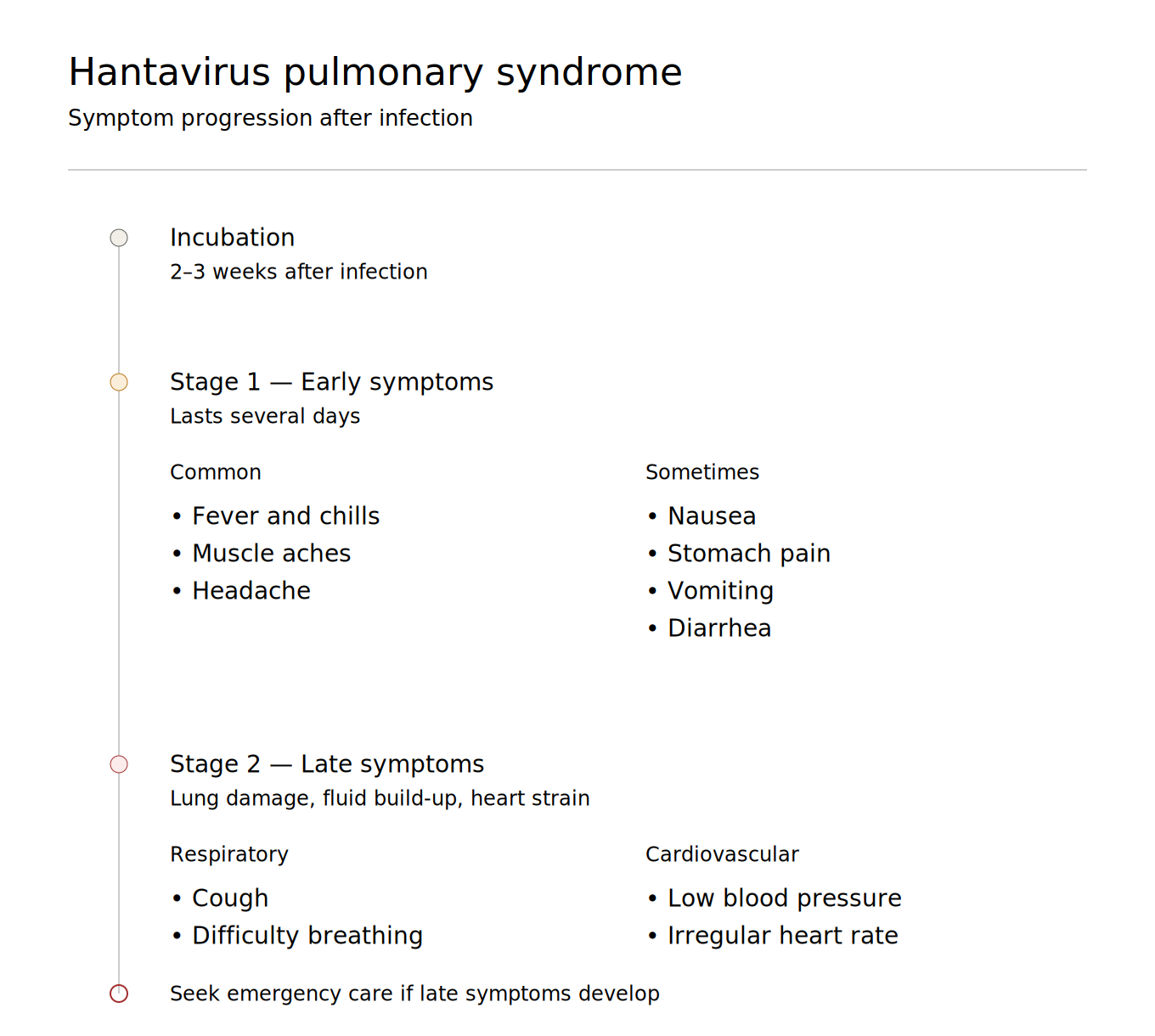
Hantavirus pulmonary syndrome (HPS) also known as hantavirus cardiopulmonary syndrome, is a rare infectious disease that begins with flu-like symptoms and progresses rapidly to more severe disease. It can lead to life-threatening lung and heart problems.
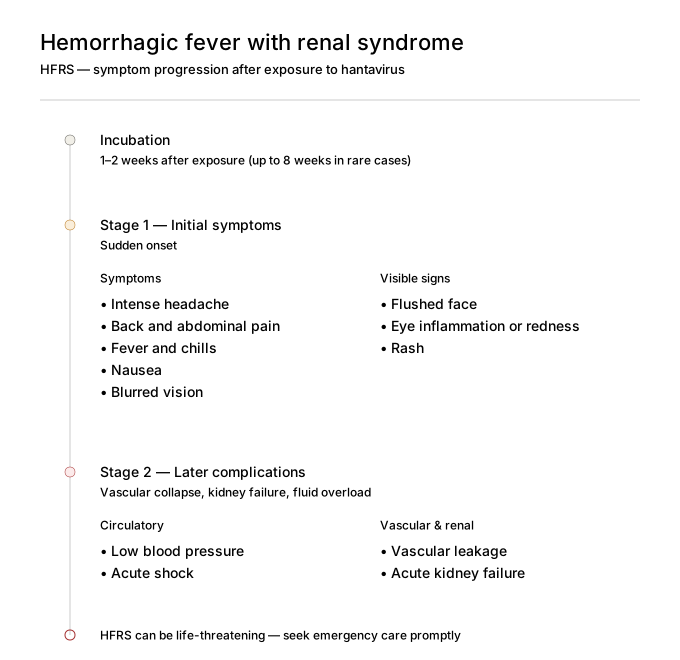
Hemorrhagic Fever with Renal Syndrome (HFRS) is an acute viral disease caused by hantaviruses usually spread to humans via rodents causing a high fever, renal failure, and internal bleeding.
The overwhelming majority of human infections occur when people inhale aerosolized particles of dried rodent urine, droppings or saliva. This interaction with the hazardous material occurs when performing activities around the house such as cleaning sheds, cabins, garages or barns where mice may have nested. Bites, contaminated food, and hand-to-mouth contact transmission is possible but rare. The only cases of person-to-person transmission has only ever been documented are for the Andes virus and only through close, prolonged contact such as between household members or unprotected caregivers. Sin Nombre virus, the strain endemic to Canada, does not spread between people.
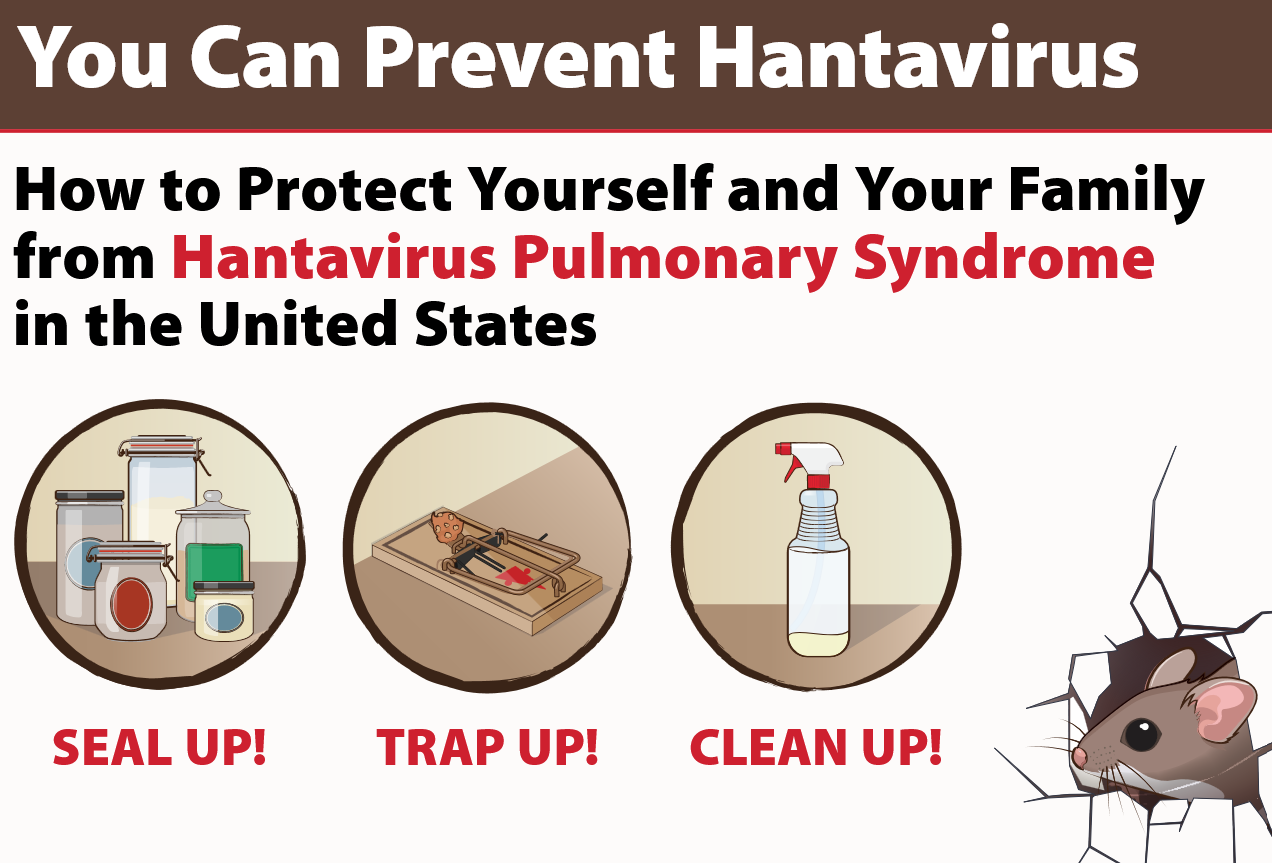
Public health agencies including the Public Health Agency of Canada (PHAC) and the U.S. CDC share the same advice: clean up wearing protective equipment and follow the steps below.
According to the Public Health Agency of Canada (PHAC), the rodent cominanted area needs to be properly clean and disinfected. Follow the steps below.
Symptoms typically appear one to six weeks after exposure (up to 42 days for Andes virus). The illness begins like a bad flu and could include other illnesses such as a fever, severe muscle aches, headaches, fatigue, sometimes nausea or diarrhea. This can suddenly progress within four to ten days to coughing, breathlessness and life-threatening pulmonary edema. There is no licensed antiviral treatment and no widely available vaccine. The only care is supportive with a focus on early ICU admission, oxygen and mechanical ventilation. Case-fatality rates run between roughly 30 and 50 per cent for HPS and Andes virus disease and ranks among the highest of any infection that regularly reaches North Americans.
Do you have a pest problem that needs to be looked at right away? Contact Guard More Pest Control about your pests and we'll work on solving your pest problem within 24 hours.