.png)


Pest Profile: Stink Bugs
Stink bugs are tiny and potential smelly troublesome household invaders. While they might look a cute shield walking around but they'll produce a chemical smell that's hard to get rid of when threatened or crushed. Stay calm as they are harmless though annoying. Learn more about stink bugs and the type of stink bugs that can be potentially seen around the Greater Toronto Area.
Last Updated: May 23, 2026
Quick Facts about Stink Bugs
Physical Identification Guide for Stink Bugs
The Brown Marmorated Stink Bug's name is described by its brown and marbled colour, and is notoriously bad smelling when disturbed. Accurate identification matters because Ontario has several native stink bug species that resemble BMSB and require different management responses.
✔ Shield-shaped body — the classic pentatomid body form that looks like a broadly triangular with a large triangular scutellum (the plate between the wing bases) that is a key visual feature; the shield outline is distinct from most other household insects.
✔ Mottled brown and grey colouring — no consistent repeating pattern with a complex mix of brown, grey, tan, and copper tones creating the marbled appearance; the surface is dull matte with no metallic sheen.
✔ Alternating banded antennae — the antennae have clearly alternating dark brown and pale white segments is one of the most reliable identifying features distinguishing BMSB from native Ontario stink bugs which usually have uniformly coloured antennae.
✔ Alternating abdominal edge banding — the exposed edges of the abdomen visible around the wing margins show alternating dark and pale bands; this banding pattern is consistent and diagnostic.
✔ Faint leg banding — pale or white bands on the femora (upper leg segments); less prominent than the antennal banding but consistent
✔ No metallic colouring — the Green Stink Bug (Chinavia hilaris) whom turns brown in fall and has a slight metallic sheen on the body surface that BMSB lacks entirely. The colour change can cause misidentification between the two stink bug species.
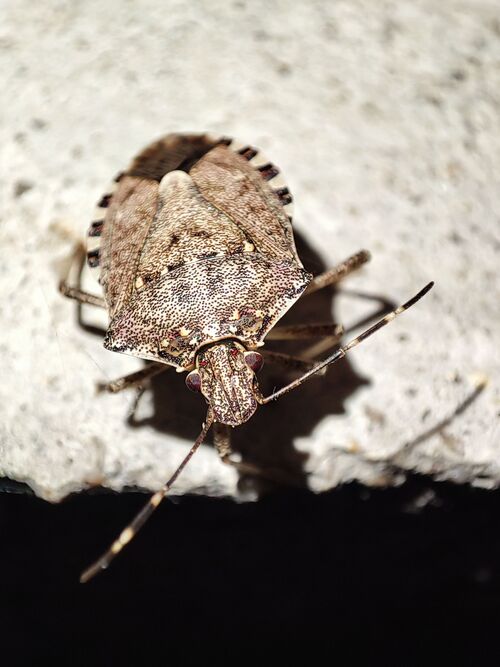
Distinguishing Brown Marmorated Stink Bug from Native Ontario Stink Bugs: Southern Ontario has several native stink bug species that can look similar to BMSB, especially in fall when some (like the Green Stink Bug) turn brown. The three most reliable field identifying features for BMSB:
1. distinctly alternating dark-and-pale banded antennae with native species having a uniform antennae.
2. alternating light-dark banding along the entire abdominal edge.
3. dull matte brown surface with no metallic sheen.
You can submit a BMSB image to the Agriculture and Agri-Food Canada's BMSB monitoring program in Ontario via email at ag.info.omafra@ontario.ca.
The Stink Bug Odour
The BMSB's defensive odour is its most notorious characteristic. Understanding the chemistry explains why managing it casually almost always makes the problem worse.
- The Chemical Composition: Stink bugs release a complex mixture of volatile aldehyde compounds (primarily trans-2-decenal and trans-2-octenal) from scent glands located on the underside of the thorax between the first and second pairs of legs. The odour is described as sharp, chemical, and similar to cilantro or coriander by some and to skunk or burnt rubber by others. The intensity varies with temperature, humidity, and the number of bugs disturbed simultaneously.
- The Dual Function (Defence and Aggregation): This is the critical behaviour pattern that makes BMSB so difficult to manage indoors. The same chemical compounds serve two distinct purposes simultaneously: they warn predators (defensive function) and they attract other BMSB to the same site (aggregation pheromone function). Disturbing or crushing indoor stink bug populations therefore actively signals other overwintering bugs hiding elsewhere in the wall void to concentrate at the same location. The more you disturb them, the more you invite.
DO NOT Crush or Swat Stink Bugs Indoors: Crushing a stink bug indoors triggers the release of both the defensive odour release and the aggregation pheromone. The result is a persistent and difficult-to-remove odour on the surface (especially fabric, carpet, and upholstery) including a chemical signal that draws more bugs from inside the wall void toward the disturbance site. It is advised to always collect indoor BMSB with a vacuum sealing the bag or canister immediately and dispose outside. Never crush them on any absorbent surface.
Stink Bug Behaviour & Biology
The Brown Marmorated Stink Bug follows a predictable four-phase seasonal cycle. Understanding this cycle is the foundation of any effective management strategy.
- Phase 1: Spring Emergence (April–May): Overwintered adults emerge when outdoor temperatures consistently reach 15–18°C usually around April to May in southern Ontario. They immediately move to host plants to feed, recover fat reserves lost during overwintering, mate, and begin laying eggs. Females lay clusters of approximately 20–30 pale green, barrel-shaped eggs on the underside of leaves. This is when BMSB are least visible and least problematic for homeowners.
- Phase 2: Summer Feeding and Reproduction (June–August): Through summer, nymphs and adults feed voraciously on a wide range of plants using their piercing-sucking mouthparts. Each feeding puncture injects saliva into plant tissue causing the characteristic damage patterns. Populations build rapidly through summer. A second generation is possible in warm Ontario summers. and orchards experience the most visible agricultural damage during this phase.
- Phase 3: Fall Aggregation and Building Entry (September–November): As the duration of daily sunlight shortens and temperatures drop, BMSB adults enter reproductive diapause (a physiological state of dormancy preparation) and begin seeking overwintering sites. They aggregate on warm exterior walls similar to Boxelder Bugs favouring south and west-facing surfaces. They enter buildings through any gap in the building envelope: around windows, doors, utility penetrations, soffits, and foundation cracks. They are strongly attracted to exterior lights during this phase.
- Phase 4: Winter Dormancy Inside Structures: Once inside wall voids, attic spaces, and window frame cavities, BMSB become dormant and largely invisible. They do not feed, reproduce, breed, or damage the structure in any way. They are simply waiting for spring. The only indoor nuisance during this phase is premature emergence on warm winter days (particularly during the January or February thaw common in southern Ontario) when heat causes them to become active and move toward light sources inside the living space.
Ontario's Growing BMSB Population: The Brown Marmorated Stink Bug population in Ontario has been expanding steadily since the 2010 Hamilton confirmation (Fogain and Graff, 2011). Agriculture and Agri-Food Canada's monitoring program in partnership with Ontario provincial partners helps track stink bug populations across the province. Niagara Peninsula orchards and vegetable operations report increasing crop damage. GTA suburban properties with fruit trees and vegetable gardens are experiencing year-over-year increases in fall aggregation numbers. Climate trends that reduce the severity of southern Ontario winters are expected to accelerate population growth.
Agricultural and Garden Impact of Stink Bugs
Ontario's Agricultural Concern: The Niagara Peninsula (Ontario's primary tender-fruit growing region for apples, peaches, and soft fruit) is the area of greatest agricultural BMSB concern in the province. Orchard operators have reported measurable crop losses since 2015, and damage levels are trending upward. Agriculture and Agri-Food Canada has designated BMSB as a regulated invasive species requiring active monitoring. GTA homeowners who grow fruit or vegetables and find unexplained blemishing, dimpling, or corky spots on their homegrown produce should consider BMSB as a likely cause.
Signs of Stink Bug Activity
✔ Shield-shaped mottled brown insects on south-facing walls in fall — aggregating on warm brick, siding, and window frames September through November often in very large numbers on sun-exposed surfaces in afternoon.
✔ Insects appearing on interior windows and walls on warm winter days — sluggish, slow-moving insects on south-facing windows in January through March which is premature emergence from overwintering sites in wall voids.
✔ Distinct sharp odour when insects are disturbed — a chemical, coriander-like smell released on disturbance; this smell is stronger and more chemically pungent than the odour from most native Ontario stink bugs.
✔ BMSB attracted to exterior lights in fall evenings — large numbers of shield-shaped insects clustering around porch lights, lit windows, and exterior fixtures on warm September and October evenings.
✔ Cat-facing or cloudy spot damage on homegrown fruit and vegetables — necrotic, dimpled, or discoloured areas on vegetables, and other susceptible crops which are often the first sign of a local BMSB population before the bugs themselves are identified.
✔ Pale green barrel-shaped egg clusters on leaf undersides — tight clusters of 20–30 pale green barrel-shaped eggs on the underside of leaves in June and July; the sighting confirms an actively breeding population on the property.
✔ Nymphs of varying sizes on host plants in summer — BMSB nymphs are distinctively patterned with bright orange and black in early instars that develop into the adult brown mottled pattern in later instars; they are found on stems, leaves, and fruit of host plants. See Brown Marmorated Stink Bug eggs image above.
Stink Bug Health Risks
Brown Marmorated Stink Bugs pose no direct health risk to humans or companion animals. The relevant concerns are nuisance and odour-related rather than medical.
✔ BMSB attracted to exterior lights in fall evenings — large numbers of shield-shaped insects clustering around porch lights, lit windows, and exterior fixtures on warm September and October evenings.
✔ Cat-facing or cloudy spot damage on homegrown fruit and vegetables — necrotic, dimpled, or discoloured areas on vegetables, and other susceptible crops which are often the first sign of a local BMSB population before the bugs themselves are identified.
✔ Pale green barrel-shaped egg clusters on leaf undersides — tight clusters of 20–30 pale green barrel-shaped eggs on the underside of leaves in June and July; the sighting confirms an actively breeding population on the property. See Brown Marmorated Stink Bug eggs image above.
⚠ Respiratory irritation from large indoor populations — the volatile compounds released by large disturbed indoor BMSB populations can cause eye, nose, and throat irritation in sensitive individuals; those with asthma or respiratory conditions may find significant indoor populations exacerbate symptoms.
⚠ Allergic reactions in sensitive individuals — a small number of individuals have reported rhinitis and conjunctivitis following exposure to disturbed BMSB populations with the aldehydes organic compounds released by defensive secretions as the likely trigger; individuals with known chemical sensitivities should treat large indoor populations with extra caution.
⚠ Staining of fabric and upholstered surfaces — crushing BMSB on fabric, carpet, or upholstered furniture deposits the odourant chemicals onto the surface; these compounds are difficult to remove from porous materials and can persist for weeks.
Our licensed technicians will locate the infestation, apply the appropriate chemical treatment in-doors, and perform a residual perimeter treatment to keep you protected from future stink bug problems.
Keep Your Home/Business Pest-Free Today
Do you have a pest problem that needs to be looked at right away? Contact Guard More Pest Control about your pests and we'll work on solving your pest problem within 24 hours.