.png)




ATTIC WILDLIFE (RACCOON, SQUIRREL, RODENT) REMEDIATION, CLEANING, & INSULATION REMOVAL
Raccoons, squirrels, and rodents don't just damage your attic. They contaminate the insulation, destroy the vapour barrier, compromise your air quality, and reduce your home's energy efficiency for years after the animals are gone. Animal removal without remediation is only half the job.
Contaminated Insultation Removal · Full-Scope Decontamination & Sanitization · Energy-Efficient Insulation Blow-In & Vapour Barrier Restorations
Last Updated: June 12, 2026


Wildlife Removal Is Step One.
Remediation Is What Protects Your Home.
Most homeowners focus on getting the animal out as the animal is the visible problem. The contaminated insulation, destroyed vapour barrier, compromised air quality, and structural damage it left behind are the expensive ones.
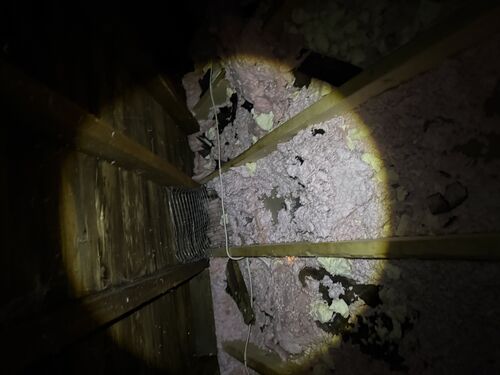
⚠️ Never Disturb Contaminated Attic Insulation Without PPE: Raccoon roundworm (Baylisascaris procyonis) eggs become airborne when dried guano is disturbed and can survive in soil and insulation for years. A 2020 Ontario study found roundworm in 35% of 1,539 tested raccoons. Inhalation can cause severe neurological disease in humans. Histoplasma fungal spores from bat and bird guano carry similar inhalation risk. Guard More Pest Control technicians use P100 respirators, full hazmat suits, and wet-application decontamination methods on every attic job. We never dry-sweeping or vacuuming without proper filtration.
Our Attic Remediation Process:
- 🦝Step 1 Wildlife Removal & Exclusion
Every remediation job begins with confirming the structure is clear. During baby season (February–August) kits must be hand-removed before any sealing. We install one-way exclusion doors, confirm departure, then permanently seal all entry points with 16-gauge galvanized steel mesh and heavy-gauge flashing. All secondary vulnerabilities on the full roofline are sealed simultaneously and not just the primary entry point. - 🧹Step 2 Attic Cleaning & Decontamination
We remove all nesting material, feces, urine-saturated debris, and dead animals using contained wet-method protocols. All waste is double-bagged in sealed biohazard bags and disposed of as regulated waste. Following physical removal, we apply Health Canada-registered biocidal disinfectants to all attic surfaces (such as joists, sheathing, rafters, and any remaining structural elements) to neutralize pathogens, bacteria, and fungal spores. - 🏚️ Step 3 Insulation Removal & Replacement
Contaminated batt or blown insulation cannot be decontaminated in place so it must be physically removed. We extract all affected insulation using HEPA-filtered vacuum equipment, inspect the vapour barrier and structural elements beneath, and replace with new blown-in or batt insulation to the current Ontario Building Code minimum R-value standard (R-60 for most Toronto attics). Restored R-value means immediate energy savings alongside restored air quality.
Attic Remediation tasks performed by Guard More Pest Control:
- 🔬Vapour Barrier Inspection & Repair
Wildlife activity (particularly raccoons, which are strong and dexterous) frequently damages or displaces attic vapour barriers. A compromised vapour barrier allows moisture into the structural framing, leading to mould growth, wood rot, and accelerating structural deterioration. We inspect the full vapour barrier during every insulation removal job and repair or replace damaged sections before new insulation is installed. - 🌬️Vent & HVAC Decontamination
Raccoons and squirrels frequently nest around and inside attic HVAC components, bathroom exhaust vents, and soffit ventilation. Contaminated ducts and vent housings circulate pathogens through the building's air supply. We inspect and clean all attic-accessible ductwork, exhaust vents, and mechanical equipment housings as part of a full remediation, and install hardware-cloth screens over all open vent penetrations to prevent re-entry. - 🔒Full Roofline Exclusion Proofing
Remediation without permanent exclusion is temporary. We conduct a full roofline inspection of every soffit intersection, plumbing stack flashing, roof vent, gable end, fascia run, and dormer junction . Then seal all vulnerabilities with 16-gauge galvanized steel mesh and commercial-grade flashing. This is the step that ensures the animal does not return. All exclusion coverings carry a lifetime warranty*.
*if exclusion is not modified or broken by humans.
Different Animals, Different Damage, Different Protocols
The contamination profile, health risks, and remediation requirements vary significantly between species. Correct species identification at the assessment stage determines the full scope of work.
- Raccoon Procyon lotor — Toronto's most common attic invader
Toronto has an estimated 100,000+ raccoons — the world's highest urban density. Raccoon roundworm (Baylisascaris procyonis) is present in approximately 35% of Ontario raccoons and can remain infectious in dried feces for years. Baby season (February–August) requires hand-removal of kits and reunion-box protocol before any exclusion sealing is possible. Full attic remediation after a multi-season raccoon occupation typically involves complete insulation removal and replacement, vapour barrier repair, structural decontamination, and full roofline exclusion.
Raccoon Risks:
Roundworms (Baylisascaris procyonis)
Leptospirosis
Structural Damage
Baby Season Complexity (baby season: peak time is April-May and sometimes August-September) - Squirrel Sciurus carolinensis — two litter seasons annually
The most significant fire risk of all GTA attic invaders. Grey squirrels chew electrical wiring because the polymer coating is a natural chewing target for a rodent with continuously growing incisors. Squirrel incisors grow approximately 6 inches (15 cm) per year. Chewed wiring in an attic is a direct fire hazard. Grey squirrels have two litter seasons in Ontario — March–April and July–August — which means there are two annual windows when kits may be present and exclusion must be approached carefully. Squirrel nesting material (shredded insulation, leaves, paper) accumulates rapidly and must be removed before decontamination is effective. Soffit and fascia damage from entry is typical; all entry points must be sealed with 16-gauge galvanized steel mesh — squirrels will gnaw through wood, plastic, and standard mesh repeatedly if the entry habit is established.
Squirrel Risks:
Wiring Damage leading to Fire
Nesting Material Buildup
Two Baby Seasons (March–April and July–August) - Mice & Rats Mus musculus & Rattus norvegicus — year-round pressure
Diffuse contamination throughout the insulation layer. Unlike raccoons (which establish a defined latrine site), mice and rats contaminate insulation moving through it constantly, urinating and defecating as they travel. A significant mouse population over one or more seasons can saturate blown cellulose or batt insulation with urine to the point where odour is detectable in the living space below. Hantavirus, though rare in Ontario, is transmitted by inhalation of aerosolised dried mouse urine and droppings. Dry-sweeping or disturbing contaminated insulation without a P100 respirator is the primary exposure risk to humans. Mouse and rat attic contamination almost always requires full insulation removal rather than partial treatment, particularly in blown-in insulation where the contamination is dispersed throughout the material.
Mice & Rats Risks:
Hantavirus
Leptospirosis
Wiring Damage leading to Fire
Odour Saturation
ℹ️ Why Correct Species ID Changes the Remediation Scope
A raccoon latrine requires spot-decontamination of a defined area and targeted insulation removal around that zone. A mouse population that has been in the attic for two years requires full insulation removal throughout. Squirrel damage requires wiring inspection before anything else. Getting the species right at the assessment stage determines the scope, the PPE protocol, the legal obligations, and the cost. These reasons are why every Guard More Pest Control wildlife remediation begins with a full species-identification attic inspection.
The Complete 7-Step
Attic Remediation Protocol
Every Guard More Pest Control attic remediation follows this sequence. Skipping steps produces incomplete results that require costly re-treatment.
- [Assessment] Full Attic Inspection & Species Identification
We access the attic and conduct a thorough assessment using thermal imaging where applicable to locate warm signatures of animals or kits. We identify the species, the extent of contamination, all entry points (primary and secondary), the condition of existing insulation, vapour barrier, wiring, and structural elements. We document findings photographically and provide a written scope of work with itemised costs before any work begins. No surprises, no hidden charges. - [Wildlife Removal] Animal Removal Including Baby Season Protocol
During baby season (February–August for raccoons; March–April and July–August for squirrels) we manually locate and remove any kits before installation of a one-way exclusion door. For raccoons, kits are placed in a heated reunion box near the entry point so the mother relocates them to an alternate den. For bats, exclusion is conducted outside the maternity season. We confirm the attic is completely clear before proceeding to decontamination.
- Thermal imaging to locate kits in insulation
- Heated padded box protocol for raccoon baby season
- One-way exclusion door installation at primary entry
- 3 to 5 day monitoring period before permanent seal - [Physical Cleanup] Nesting Material & Fecal Debris Removal
Our team uses Full PPE: P100 respirators, hazmat suits, nitrile gloves, boot covers to remove contaminated debris. All nesting material, feces, food caches, and dead animals are physically removed using wet-application methods — never dry-sweeping or unfiltered vacuuming, which aerosolises pathogen-containing dust. All nesting materials, food debris, and visible droppings are carefully removed and disposed of via biohazard bags. - [Insulation Removal] Extraction of Contaminated Insulation
All contaminated insulation is extracted which is critical to prevent re-aerosolisation of any remaining pathogens during removal. We remove insulation in sections, working from the eave edges inward, bagging material as we go. The vapour barrier beneath the insulation is inspected during extraction; damaged or displaced sections are flagged for repair or replacement. Wiring condition is assessed at this stage — any evidence of gnawing damage is documented and the homeowner is advised to engage a licensed electrician before insulation replacement. - [Decontamination] Biocidal Disinfection of All Attic Surfaces
Following physical removal, we use a fogger to spray an enzymatic or antimicrobial disinfectant to kill off bacteria, fungi, and airborne pathogens. This process will disinfect all the joists, rafters, sheathing, top plates, and all structural elements. The disinfectant is selected based on the pathogens documented or suspected for the species involved and a general-purpose disinfectant is not appropriate for Baylisascaris roundworm-contaminated sites, which require specific Health Canada-registered and approved products with documented roundworm-egg kill efficacy. All surfaces are allowed to dry fully before insulation installation. - [Insulation Replacement] New Insulation to Ontario Building Code R-Value
New insulation is installed to current Ontario Building Code minimum standards which is R-60 for most Toronto attics (up from the R-20 that was standard in pre-1980 homes). We offer blown-in fibreglass: non-organic so it does not provide a food source for insects or mould, maintains R-value even in high humidity, and recommended for attics with persistent moisture concerns. Vapour barrier repairs are completed before insulation is installed. - [Permanent Exclusion] Full Roofline Seal with Lifetime Warranty
The final and most critical step of attic remediation: every vulnerability on the roofline is sealed and not just the primary entry point, but every secondary weakness: soffit intersections, plumbing stack flashings, roof vents, gable ends, fascia runs, dormer junctions, and chimney caps. All exclusion hardware is 16-gauge galvanized steel mesh or heavy-gauge galvanized flashing. We never use foam sealant, which animals chew through in hours, and never plastic mesh, which degrades within two to three seasons in a Toronto climate. All exclusion coverings carry Guard More Pest Control's exclusions lifetime warranty*. A follow-up inspection at 30 days confirms no re-entry.
*if exclusion is not modified or broken by humans.
Attic Wildlife Remediation Frequently Asked Questions
A: It depends on the species and the extent of contamination. Raccoon latrine sites can sometimes be spot-treated if the contamination is localized and the surrounding insulation is intact. However, mouse and rat contamination is diffuse with the animals move constantly through the insulation layer, urinating and defecating throughout — and in-place cleaning is not effective. When in doubt, removal and replacement is always the higher standard and eliminates the risk of residual contamination. We assess this honestly at the inspection stage and only recommend full removal when it's genuinely warranted.
Q: Can raccoons be removed from an attic in spring and summer?
A: Yes, but baby season (mid-February through August) requires a different protocol. A one-way exclusion door cannot be installed safely when kits are present but they cannot follow the mother out and will starve inside the attic. Our NWCOA-certified technicians enter the attic, use thermal imaging to locate any kits, hand-remove them, and place them in a heated reunion box near the entry point. A one-way door is then installed. The mother finds her kits and relocates them to an alternate den site. Once she's confirmed clear, we remove the one-way door and permanently seal the entry with galvanized steel. This process typically takes 3–7 days from first visit to permanent seal.
Q: How dangerous is raccoon feces in my attic?
A: Raccoon feces carries Baylisascaris procyonis roundworm, which can cause severe neurological damage in humans if ingested or inhaled. A 2020 Ontario study found roundworm eggs in approximately 35% of tested raccoons. The eggs become infective 2–4 weeks after deposit and can survive in soil and insulation for years — long after the raccoons are gone. They are not killed by standard household cleaning products. Professional decontamination requires specific EPA/Health Canada-registered products with documented roundworm-egg kill efficacy, applied wet to prevent aerosolisation. Never dry-sweep, vacuum without HEPA filtration, or disturb raccoon feces in an attic without proper PPE.
Q: What R-value should my attic insulation be?
A: The current Ontario Building Code minimum for attic insulation in Toronto is R-60 (effective insulation, Part 9 residential). Most Toronto homes built before 1975 have original insulation at R-11 to R-20 — far below this standard. Homes built in the 1980s typically have R-20 to R-28. Upgrading from R-20 to R-60 reduces attic heat loss by approximately 67% and can lower annual heating costs by 15–30% in a typical GTA home. We install to R-60 as the standard on all replacement jobs and provide written R-value certification at project completion.
Q: Does home insurance cover attic wildlife damage in Ontario?
A: This varies significantly by policy and insurer. Most standard homeowner policies in Ontario exclude damage caused by rodents and insects. Wildlife damage (raccoons, squirrels) occupies a grey area — some policies cover sudden and accidental damage from wildlife entry but exclude gradual damage from an ongoing infestation. Some policies cover resulting water damage (e.g., from a damaged roof) but not the remediation itself. We recommend contacting your insurer before work begins to understand if any portion may be covered.
Q: How long does a full attic remediation take?
A straightforward single-animal entry, removal, decontamination, and insulation replacement in an average Toronto semi-detached or detached attic typically takes 2–4 days across 2–3 visits: inspection and one-way door installation on day one; decontamination and insulation removal on day two (once the attic is confirmed clear); insulation replacement and final exclusion on day three. Baby season jobs add 3–7 days for the reunion process between visit one and visit two. Complex jobs — large attics, multiple entry points, extensive contamination — may take longer. We provide a realistic timeline at the assessment stage.
Related Wildlife Management Services
Keep Your Home/Business Pest-Free Today
Do you have a pest problem that needs to be looked at right away? Contact Guard More Pest Control about your pests and we'll work on solving your pest problem within 24 hours.