.png)


Pest Profile: Pigeons
Pigeons might seem like a minor nuisance but a pair of birds on your rooftop today can become a colony of dozens within a single season. Their droppings are highly acidic, their nests block drainage and HVAC systems, and the pathogens they carry pose a documented risk to building occupants. Feral pigeons are one of the most damaging and often underestimated pest species affecting homes and commercial properties across Toronto and the GTA.
Last Updated: May 24, 2026
Quick Facts about Pigeons
Physical Identification of Pigeons
The feral pigeon is one of the most recognisable urban birds in the world but accurate identification matters when distinguishing them from protected species such as Mourning Doves or Band-tailed Pigeons, which require different management considerations.
✔ Stocky, compact body — broad chest, short neck, and rounded head; significantly more robust in build than Mourning Doves, which are slender with a long pointed tail and are a protected species.
✔ Blue-grey wild-type plumage — the classic colouring; iridescent green and purple feathers on the neck (visible in direct light), two distinct dark bars across the folded wings, and a white rump patch that is diagnostic in flight.
✔ Wide colour variation in urban flocks — feral populations often contain brown, white, black, chequered, or mixed-colour birds due to generations of domestic breeding; all are the same species regardless of colour.
✔ Characteristic waddling walk — pigeons bob their head while walking — a distinctive behavioural trait shared by few other urban bird species; they are equally comfortable on the ground and on elevated structures.
✔ Cooing vocalisation — a repetitive, multi-syllable "coo-ROO-coo-coo" call; groups at roosting sites produce a constant low murmuring sound that is a reliable indicator of an established roost.
✔ Orange-red eyes and pink feet — bright orange-red iris visible at close range; pink to red legs and feet; young birds (squabs) have dark eyes that lighten with age.
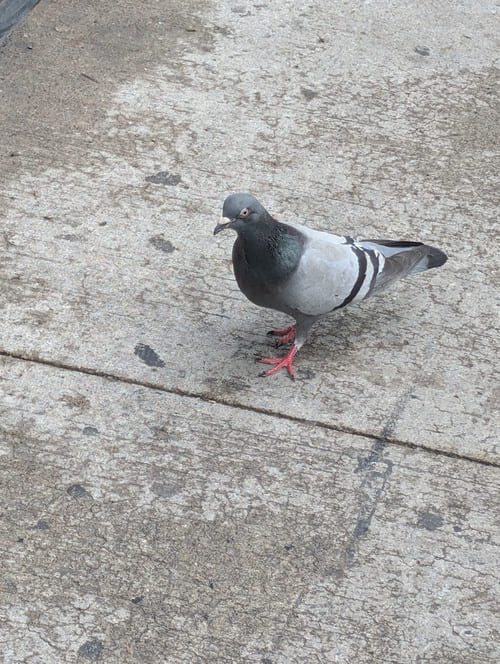
Image: City Pigeon
Pigeon Legal Status in Ontario — Important for Commercial Management
Feral pigeons (Columba livia domestica) are not protected under the federal Migratory Birds Convention Act in Canada, as they are a non-native, introduced species. This means removal, exclusion, and population control measures do not require a federal permit. However, eggs and nesting activity of other bird species (House Sparrows and European Starlings are also unprotected; all native species are protected) must be properly identified before any nest or egg removal. Guard More Pest Control's technicians must identify the species before any work proceeds.
Read the Canada's Migratory Birds Convention Act here.
Pigeon Behaviour & Biology
Understanding pigeon behaviour is the foundation of effective long-term control. Pigeons are creatures of habit with strong site fidelity as they return to the same roost, the same feeding areas, and the same nesting sites year after year. This makes early intervention very critical because the longer an active roosting population is permitted to establish, the harder and more expensive it becomes to remove.
- Site Fidelity (The Core Management Challenge): Pigeons have an extraordinarily strong homing instinct and attachment to established roosting and nesting sites. Birds that have roosted on a ledge for one season will attempt to return to that exact location repeatedly even after exclusion measures have been installed. This behaviour is why exclusion must be comprehensive and permanent because any gap or failure in proofing will be exploited by returning birds. Pigeon relocation without exclusion is universally ineffective as the removed birds return or are replaced by others from the same population.
- Feeding Behaviour and Urban Food Sources: Urban pigeons are sustained almost entirely by human food sources: deliberate feeding by the public, uncovered garbage and waste bins, spilled grain near food processing facilities, restaurant trash, and grease trap areas. A pigeon requires approximately 30–35 grams of food per day and rarely forages more than 1–2 km from its roosting site. Eliminating or securing food sources is a necessary component of long-term population management because exclusion alone without food source reduction produces slower results in high-density feeding areas.
- Year-Round Breeding in Sheltered Urban Sites: Unlike most wild bird species, feral pigeons breed continuously throughout the year in sheltered urban locations and not just in spring/summer times. A mated pair in a protected rooftop or warehouse environment can produce 6–8 clutches of 2 eggs per year. Each clutch takes 17–19 days to hatch, and squabs (baby pigeons) fledge in approximately 4 weeks. This means a population left unmanaged can double in a single season. Pigeon management must begin before an established breeding population develops.
- Guano Accumulation (A Compounding Problem): A single pigeon produces approximately 10–12 kg of droppings per year. A roost of 50 birds (a modest urban colony) generates over 500 kg of guano annually. Pigeon guano is highly acidic (pH 3–4.5) and causes accelerating damage to concrete, metal, stone, roofing membranes, and painted surfaces. Accumulation also creates an increasingly suitable habitat for the next generation of birds because guano buildup provides thermal insulation, nesting material, and a substrate that physically signals "safe site" to other pigeons. The longer accumulation is allowed to continue, the more expensive and technically demanding the remediation.
- Social Structure and Flock Dynamics: Pigeons are highly social birds that roost, forage, and breed in groups. A single established pair that is not excluded attracts additional birds to the site with other pigeons identify occupied roosting ledges as desirable locations and join the roost. This is why early action on even a small number of birds (2–6) produces dramatically better results than waiting until the population grows to 20–50. A pigeon problem that is considered "small" going unaddressed for one breeding season typically becomes a significantly larger and more expensive problem.
Pigeon Health Risks
Pigeons pose more significant and diverse health risks than most urban pest species. The risks come from three distinct pathways: droppings, feathers and dander, and ectoparasites (mites, ticks, fleas, and lice that live on the birds). Each requires separate consideration for building occupants and remediation workers.
The following diseases are directly associated with pigeon droppings, feathers, or ectoparasites:
Guano Remediation Requires Proper PPE (Personal Protective Equipment)
Dry pigeon guano becomes airborne dust that is easily inhaled during cleaning. Workers disturbing accumulated droppings without proper respiratory protection (P100 respirator at minimum; supplied-air respirator for heavy accumulations) risk inhalation exposure to Cryptococcus neoformans, Histoplasma capsulatum, and other pathogens that are concentrated in dried guano. DO NOT dry-sweep or use compressed air to clean pigeon droppings. Guard More Pest Control uses wet application methods and full PPE for all guano remediation work.
Pigeon Droppings and DineSafe — Commercial Property Owners
Under Toronto Public Health's DineSafe program, pigeon droppings on or near food preparation areas, ventilation equipment, or food storage constitute a significant violation or immediate closure to correct the health risk issue. Restaurants, food retailers, and food processing facilities with rooftop pigeon activity that allows guano to enter the building via HVAC, open windows, loading areas, or rooftop exhaust vents face immediate closure risk. Guard More Pest Control works to establish and maintain bird-free rooftop environments that satisfy DineSafe requirements.
Structural and Property Damage caused by Pigeons
Beyond the health risks, pigeons cause direct, measurable, and accelerating physical damage to buildings and equipment. The costs of remediation and repair consistently exceed the costs of early prevention.
Signs of Pigeon Activity
- Visible birds roosting on ledges, roofline, or equipment — regular presence of the same birds at the same location, particularly in early morning and late afternoon; pigeons return to established roosts predictably and are not deterred by casual disturbance.
- Accumulation of droppings on horizontal surfaces — white-grey guano deposits on window ledges, sills, AC units, rooftop equipment, and the ground directly below roosting sites. Fresh pigeon droppings are semi-liquid and white-grey with older accumulations being grey-brown and crusted.
- Nesting material on ledges, in HVAC equipment, or in vents — loose accumulation of twigs, straw, feathers, string, and debris on any flat or concave surface with overhead shelter; pigeon nests grow continuously and become solid, compacted platforms with successive seasons of use.
- Constant cooing vocalisations — the persistent low murmuring of a roost is often audible before the birds are visible; particularly noticeable in the early morning and around rooftop plant rooms, parapet walls, and mechanical equipment areas.
- Feathers and dead birds near the roost site — moulted feathers accumulate in gutters, drains, and at the base of roosting structures; dead birds found beneath a roost indicate an established long-term colony rather than transient roosting.
- Clogged drains and gutters — blockages in roof drainage that are not explained by leaf fall or seasonal debris often contain feathers, nesting material, and compressed guano. Drainage blockages are frequently the first sign noticed by building maintenance staff.
- HVAC efficiency reduction or unusual odours — unexplained drops in HVAC performance, unusual odours from air handling systems, or visible debris in air intakes are indicators of nesting activity in or near rooftop mechanical equipment.
- Mite activity indoors following recent bird exclusion — small crawling mites on window sills, walls, or ceilings near former roost sites after birds have been excluded. The classic sign of the bird mite migration that occurs when the host is removed without concurrent nest and guano remediation.
Image: Bird Mites On and Next to Human Finger
What Attracts Pigeons to Your Property
Residential vs. Commercial Pigeon Considerations
GuardMore Pest Control is Ontario MECP licensed, a HomeStars 'Best of' 2026 winner, and a member of the National Wildlife Control Operators Association (NWCOA). Our technicians bring that same rigour to every pigeon inspection, guano remediation, and exclusion installation for residential balconies and commercial rooftops alike, across the Greater Toronto Area. Contact Guard More Pest Control for a pigeon control quote today.
Keep Your Home/Business Pest-Free Today
Do you have a pest problem that needs to be looked at right away? Contact Guard More Pest Control about your pests and we'll work on solving your pest problem within 24 hours.