.png)



Pest Profile: Carpet Beetles
Carpet beetles belong to the family Dermestidae which is a group of fabric-destroying insects found across North America that includes hide beetles, museum beetles, and larder beetles. Most beetles are harmless as adults but their larvae feed voraciously on keratin-based natural materials. These materials are wool, silk, leather, feathers, and animal hair. Once carpet beetle larvae establish inside a home or commercial property, they are difficult to eliminate because of their long life cycle. They live in dark undisturbed areas which standard surface treatments cannot reach the larval populations hidden inside carpet backing and subfloor voids. The three species most commonly found in Ontario homes and commercial buildings are the Varied Carpet Beetle, the Black Carpet Beetle, and the Furniture Carpet Beetle.
Last Updated: July 31, 2026
Carpet Beetle Biology and Life Cycle
The Three Ontario Carpet Beetle Species You Need to Know
While over 500 species of Dermestidae exist worldwide, three species account for the vast majority of carpet beetle infestations in Ontario homes and commercial properties. Species identification matters because feeding behaviour, preferred materials, and treatment focus differ between them.
- Varied Carpet Beetle (Anthrenus verbasci): The most common carpet beetle species in Ontario. Distinctive mottled pattern of white, yellow, and brown scales on a black body resembling a tiny mosaic tile. Adults are 2–3 mm. Larvae prefer wool carpet, wool clothing, and natural fibre upholstery. Found across all Greater Toronto Area building types. Adults are strongly attracted to light and are commonly found on interior windowsills in spring and summer.
- Black Carpet Beetle (Attagenus unicolor): The most destructive species by individual larval impact. Uniformly dark brown to black, oval-shaped adult, 3–5 mm. Larvae are noticeably larger than other species (up to 7 mm) with a distinctive tuft of long golden-brown hairs at the tail end. Feed on a wider range of materials than other species — including stored food products, dried animal products, and synthetic/natural fibre blends. Infestations tend to be more persistent and harder to eliminate because of this broad diet.
- Furniture Carpet Beetle (Anthrenus flavipes): Similar in size and appearance to the Varied Carpet Beetle but with distinctly white and yellow scale patterning. 2–3.5 mm. As the name suggests, this species preferentially infests upholstered furniture especially on wool and down-filled pieces rather than floor carpet. Infestations are often confined to a single chair, sofa, or mattress, making them easy to miss in a general carpet inspection. A thorough furniture inspection is required for accurate assessment.
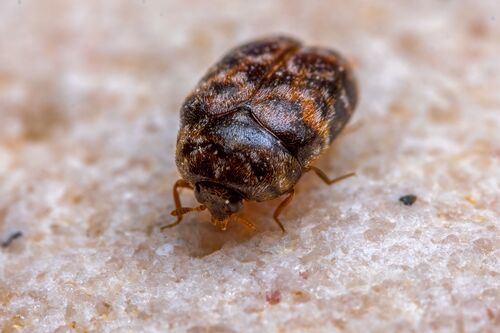
Image: Brown Carpet Beetle (source: Pexels Royalty Free Stockphotos, Photographer: Rafael Minguet Delgado)
Why Species Identification Matters for Treatment: Treating a Black Carpet Beetle infestation with a protocol designed for Varied Carpet Beetle often produces incomplete results. The Black Carpet Beetle's broader diet means secondary feeding sites such as stored food, dried goods, bird nests in the building fabric. These feeding sites may be sustaining the population independently of the carpet. A Guard More Pest Control inspection identifies the species present before treatment begins, which directly determines where treatment is focused and which secondary harbourage sites are assessed.
Carpet Beetle Lifecycle and Biology
The carpet beetle life cycle is the most important thing to understand about why infestations are so difficult to detect early and so persistent once established. The stage that causes all the damage is the larva and at the larva stage is least visible, least active near surfaces, and least affected by standard surface insecticide applications.
The Multi-Year Hidden Infestation Problem: A carpet beetle larval population established under a carpet in Year 1 may not produce visible adult beetles or signs of an carpet beetle infestation such as fabric damage until Year 2 or Year 3. By that point, the population is well established across multiple generations, the subfloor gap is heavily contaminated with cast skins and frass, and remediation costs are significantly higher than early intervention. Early monitoring is the most cost-effective carpet beetle strategy available.
What Carpet Beetles Feed On
Carpet beetles have a broader diet than most fabric pests and this is one of the reasons that are so persistent. Even after the primary feeding site is treated, secondary food sources in the same building can sustain the population indefinitely.
Bird Nest are a Hidden Re-Infestation Source: One of the most overlooked sources of persistent carpet beetle re-infestation in older GTA buildings is a bird nest in the roof space, soffit, or wall cavity. Bird nests contain feathers, down, and dried organic material. These materials are ideal carpet beetle food sources serves as continuous reservoir population that re-introduces beetles into the building season after season. If a commercial property experiences repeated carpet beetle infestations despite thorough treatment, a roof space inspection for bird nesting activity is a standard diagnostic step in a Guard More Pest Control investigation.
Carpet Beetle Health Risks
Carpet beetles are not disease vectors and do not bite. Their health impact operates through two distinct mechanisms (both are consistently misdiagnosed in commercial and residential settings):
1. Physical irritation from larval hairs.
2. Allergic sensitization from prolonged exposure to beetle proteins .
- Carpet Beetle Dermatitis — The Bed Bug Misdiagnosis: The bristly hairs (hastisetae) shed by carpet beetle larvae cause a characteristic skin rash in sensitive individuals — small, red, intensely itchy welts on exposed skin that closely resemble bed bug bites in both appearance and distribution. This leads to systematic misdiagnosis: the building is inspected for bed bugs, the inspection returns negative, and occupant complaints continue while the carpet beetle source goes unidentified. In any setting where occupants report unexplained skin irritation and bed bug inspection returns negative, carpet beetle larval activity should be the immediate next investigation.
- Allergic Alveolitis — Prolonged Exposure Risk: Prolonged exposure to airborne carpet beetle proteins — shed larval hairs, cast skins (exuviae), and frass particles — can cause hypersensitivity pneumonitis in susceptible individuals. Symptoms include persistent cough, breathlessness, and fatigue that improve when the individual is away from the building and worsen on return. This condition is an occupational health concern for building maintenance workers, museum collection staff, and long-term occupants of heavily infested buildings.
No Direct Disease Transmission: Carpet beetles do not bite, sting, or transmit any disease to humans or animals. They do not infest living tissue. The health impacts described above are caused by larval hairs and airborne proteins which are not caused by the beetle making direct contact. Pets can carry carpet beetle larvae into the building on their coats but the beetles DO NOT parasitize (live on a host) or harm the animal.
Signs of Carpet Beetle Activity
- Shed larval skins (exuviae) at perimeter edges and under furniture — hollow and bristly brown casings measuring 4–7 mm long that look like a shrunken larva; they accumulate near feeding sites and persist long after the active larvae have moved on; large numbers of exuviae indicate a long-established, multi-generation population.
- Irregular surface damage to wool carpet or natural fibre rugs — larvae feed from beneath, creating irregular bare patches or thinned areas in the pile that are not caused by wear; damage is worst at perimeter edges, under furniture, and in low-traffic areas — the opposite pattern from wear damage.
- Holes in wool, cashmere, silk, or leather garments — irregular holes through fabric, particularly at folds and seams where larvae shelter; synthetic fabrics are not damaged but may show holes where larvae burrowed through to reach natural fibres beneath.
- Adult beetles on windowsills and near light fittings — small (2–5 mm), slow-moving, oval beetles on interior windowsills and often mistaken for small weevils or seeds; adults cluster near windows because they are trying to escape outdoors; their presence is a reliable indicator that larvae are active somewhere in the building.
- Frass (larval excrement) near feeding sites — small, dark, sand-like pellets accumulating beneath carpet edges, in the seams of upholstered furniture, and in wardrobes near infested materials — a strong indicator of active larval feeding.
- Skin irritation and unexplained rash in building occupants — particularly when bed bug inspection returns negative; carpet beetle dermatitis follows a characteristic pattern — welts on exposed skin, worse after sitting on or near infested upholstery or walking on infested carpet in bare feet.
- Positive sticky trap catches near carpet perimeter zones — adult carpet beetles are caught by sticky traps placed at carpet perimeter edges and near windows; a monitoring program using sticky traps is the most reliable early-detection tool available for commercial properties.
- ⚠ Thin or worn-looking carpet in low-traffic areas — larvae feed most heavily in undisturbed zones so carpets that look worn or thinned in areas that receive little foot traffic is a red flag for larval feeding rather than wear damage and warrants immediate inspection.
Commercial Settings at Highest Risk for Carpet Beetles
Carpet beetles are a risk in any building with natural fibre materials but there are certain commercial settings that create favour conditions for carpet beetle establishment and persistence.
Prevention During New Carpet Installation: The most cost-effective point to prevent carpet beetles in a commercial property is before the carpet goes down. A residual insecticide applied to the subfloor before installation, combined with synthetic underlay specification, tight perimeter fitting, and a 30-day post-installation monitoring trap program, dramatically reduces the risk of a larval population establishing in the first season. Guard More Pest Control works with commercial flooring contractors and property managers to integrate pest prevention into the installation process from the planning stage.
Our licensed technicians identify the carpet beetle species accurately before any treatment begins by conduct a systematic inspection to locate and map all larval feeding zones, shed skin accumulations, and secondary harbourage sites. Followed by applying Health Canada-registered residual insecticides and insect growth regulators to all affected areas and schedule follow-up visits at 60 and 90 days to treat larvae emerging from eggs and pupae that survived the initial application. Our work is backed by our 30-day guarantee.
Keep Your Home/Business Pest-Free Today
Do you have a pest problem that needs to be looked at right away? Contact Guard More Pest Control about your pests and we'll work on solving your pest problem within 24 hours.