.png)

What Do Squirrels Eat?
Last updated:
August 15, 2026

The Eastern Grey Squirrel is the species most GTA homeowners know best. They can be climbing and hopping across on backyard fences, knocking down bird feeders, burying things in lawns, and occasionally finds its way into an attic. It is one of the most adaptable urban mammals in North America, and much of that adaptability comes down to what it eats: a surprisingly varied, seasonally shifting diet that makes almost any residential property a viable food source for at least part of the year.
A squirrel does not simply find food. It remembers where food is with remarkable precision recalling 85% of their cached food. Eastern Grey Squirrels can recall the locations of thousands of individual cached food items months after burying them.
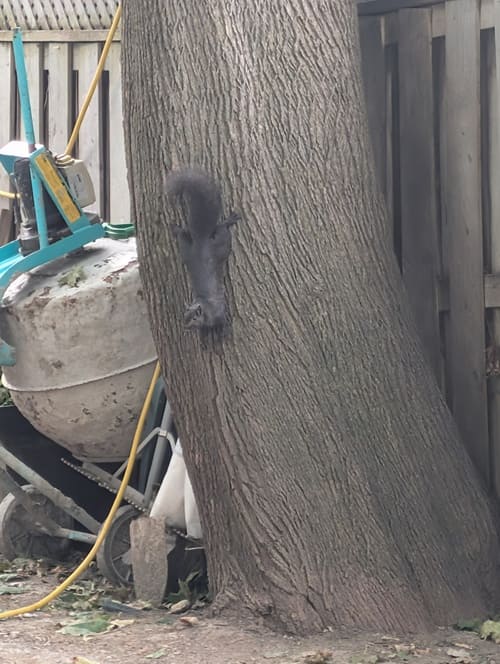
Eastern Grey Squirrels are primarily herbivores but are more accurately described as opportunistic foragers. Their core diet is built around seeds, nuts, and plant matter, but they supplement this with fungi, insects, bird eggs, and occasionally small vertebrates when plant food is scarce or when caloric demands are high. In urban and suburban environments they have also added human food waste, bird seed, and garden produce to their repertoire.
One of the most distinctive features of squirrel foraging behaviour is caching. Caching is the practice of burying individual food items in scattered locations across their home range for later retrieval. Eastern Grey Squirrels engage in what is called “scatter hoarding” because unlike some animals that maintain a central food store, squirrels bury thousands of individual items in separate locations, typically a few centimetres below the soil surface. They rely on a combination of spatial memory and smell to recover these items, successfully retrieving most (at least 85%) but not all. The forgotten caches that are never retrieved eventually sprout into trees, making squirrels one of the most important seed-dispersal agents in North American deciduous forests.
The Eastern Grey Squirrel’s natural diet overlaps heavily with what a typical GTA yard has to offer. The trees, gardens, and food waste that define residential neighbourhoods in Toronto, Mississauga, Markham, and across York Region provide exceptional foraging territories.
The most common GTA homeowner encounters with squirrels are all diet-driven:
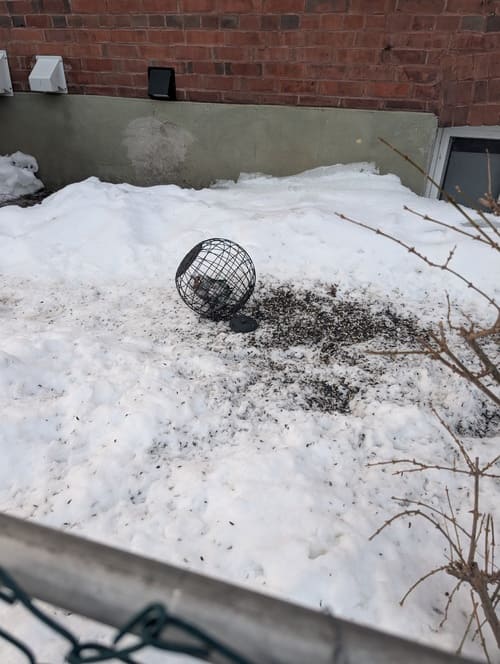
A squirrel’s diet is closely tied to what is available, and that changes dramatically across the year. The GTA’s four distinct seasons create four genuinely different foraging patterns.
Spring — emerging from a lean winter
Summer — abundance and selective eating
Fall — hyperphagia (hunger that doesn't go away after eating) and intensive caching
Winter — living off cached stores
The frantic activity visible in GTA squirrels from September through November is driven by one of the most powerful biological imperatives in their annual cycle: the need to cache enough food to survive winter. Unlike raccoons, which build fat reserves through hyperphagia and den through cold periods, squirrels do not hibernate or enter torpor. They remain fully active through Ontario winters, relying entirely on cached food stores and continuing to forage whenever temperatures allow.
A single Eastern Grey Squirrel may cache between 3,000 and 10,000 individual food items in a single autumn season. The pace of this caching activity is nearly continuous during daylight hours in October. This is the season when squirrel-related property damage and complaints spike in the GTA, because the same energy driving the caching behaviour also drives the squirrel to explore new territory, including rooflines.
The squirrel investigating your roofline in October is not just looking for shelter. It is also mapping potential food storage sites. An accessible attic represents both a warm den and a protected cache.
The link between fall feeding behaviour and attic intrusion is direct: a squirrel that has identified an accessible entry point in your roofline during its October territory exploration is highly likely to use it as a den site. This is why fall exclusion work is the most cost-effective form of squirrel management.
A squirrel inside your attic is a structural and safety risk as their gnawing damages wiring, insulation, and framing continuously potentially causing a fire in the affected property. If you hear rapid daytime scurrying in the attic, or see gnaw marks on your fascia board or soffit, contact Guard More Pest Control at contact@guardmorepests.com to receive a quote for squirrel inspection today.
Do you have a pest problem that needs to be looked at right away? Contact Guard More Pest Control about your pests and we'll work on solving your pest problem within 24 hours.