.png)

What Do Raccoons Eat?
Last updated:
August 15, 2026

The raccoon is one of the most successful urban animals on the planet and a significant part of that success comes down to what it is willing to eat which is almost everything. Raccoons are true omnivores with a flexible, opportunistic diet that shifts with the seasons, the availability of food, and the environment they find themselves in. A wild raccoon in a rural woodland eats a different menu than a raccoon navigating the back lanes of Toronto. Both rural and urban raccoons share the same fundamental drive to eat whatever is most available, most calorie-dense, and easiest to obtain.
By understanding what raccoons eat helps homeowners explain why they visit your yard, raid your garbage, and target specific parts of your home and property. Every choice a raccoon makes about where to forage is a nutritional decision. A raccoon does not have a preferred food. It has a preferred strategy which is to find the highest-calorie food available with the least effort required to obtain it.
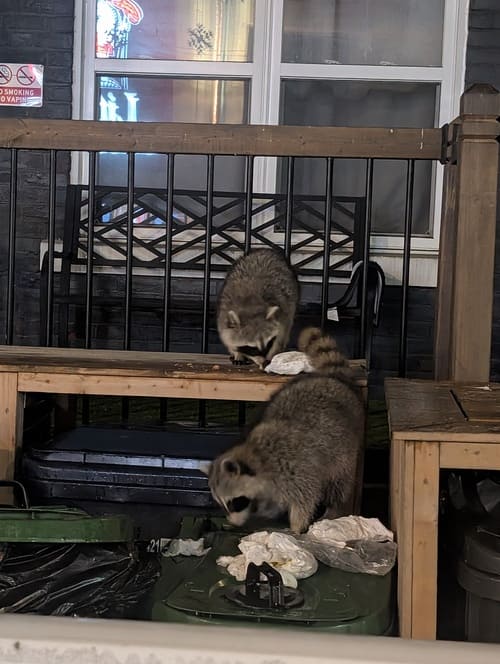
The raccoons living in the Greater Toronto Area, Mississauga, and Richmond Hill eat a diet that would be unrecognizable to their rural relatives. Urban raccoons have access to a reliable, year-round buffet that wild raccoons would never encounter: human food waste. This is why GTA raccoons are notably larger and healthier than rural raccoons in many studies because the urban food supply is calorie-dense, consistent, and requires almost no hunting or foraging skill to access. Raccoons are known for their ability to lift levers, open jars, and open latches with their five-fingered front and back paws. We recommend always keeping your garbage and compost bins locked up so they cannot access them.
The specific foods urban raccoons target in the GTA include:
In a natural setting, a raccoon’s diet is roughly 40 percent invertebrates, 33 percent plant matter, and 27 percent vertebrates and other animal material, though these proportions shift significantly with the season.
Spring — protein after a lean winter
Summer — fruit, berries, and abundant insects
Fall — hyperphagia (hunger that doesn't go away after eating): eating to build fat reserves
Winter — opportunistic and reduced activity
Fall is when raccoon feeding behaviour reaches its most intense and aggressive phase. In preparation for the reduced activity of winter, raccoons enter a state called hyperphagia (definition: extreme, abnormal, and insatiable hunger that does not go away after eating) which is a biologically driven compulsion to eat as much as possible in order to build the fat reserves they will need to survive cold snaps and lean months. In this phase, a raccoon may consume up to three times its normal daily caloric intake.
Fall is the season when raccoon raids on garbage bins, compost heaps, and gardens become most frequent and most destructive. It is also when raccoons that were previously visiting a property occasionally become nightly or even twice-nightly visitors. A raccoon in hyperphagia will work harder and take more risks to access food than it would at any other time of year.
Toronto homeowners who find their garbage bins raided night after night through September and October are almost always dealing with a raccoon in this feeding surge. The solution is not deterrence, it is elimination of the food source through locking away garbage/compost bins, clearing fallen fruit, and storing pet food.
to other animals are consumed without issue by raccoons, whose digestive systems are unusually robust. A few notable exceptions:
It is worth noting that several foods genuinely toxic to raccoons (this list includes grapes, raisins, chocolate, macadamia nuts, and the artificial sweetener found in sugar-free products called Xylitol. They are foods raccoons may encounter in human waste. These should not be placed in accessible compost or open waste containers.
Removing food sources is the first and most important step for raccoons foraging in your yard. But if raccoons have already established a den in your attic, walls, or crawlspace, the motivation is shelter rather than accessing food. A licensed wildlife removal professional can assess, safely remove, and permanently exclude raccoons from the building envelope. Contact Guard More Pest Control at contact@guardmorepests.com to receive a quote for raccoon removal and/or exclusion installation today.
Do you have a pest problem that needs to be looked at right away? Contact Guard More Pest Control about your pests and we'll work on solving your pest problem within 24 hours.