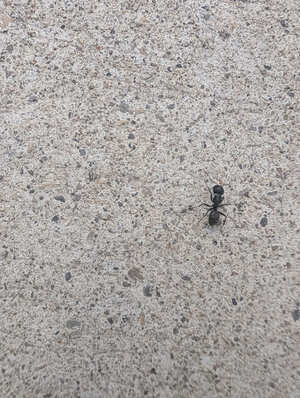
Ants are among the most persistent household pests in Canada. The reason most people can't get rid of them is that they're targeting the wrong ants which are the visible ones walking around. The ants that need to be targeted are in their colonies. Permanent elimination of ants means finding and destroying the colony as well as removing everything that keeps drawing them back.
The most important thing to understand: The ants trailing across your kitchen floor are worker ants representing only a fraction of the colony. The source of the infestation is the the ant queen whom could be potentially hundreds of metres away or deep inside a wall void. Until the queen is eliminated, the colony survives and rebuilds no matter how many workers you kill. The identification the ants species (species: carpenter ant, pavement ant, pharaoh ant, odorous house ant) is super important as it determines the type of ant treatment, you can identify the type of ant via our ant pest profile.
500k workers a single carpenter ant queen can produce over her lifetime.
20+ yrs lifespan of a queen ant is the reason colonies keep coming back.
72 hrs how quickly a slow-acting bait can reach and kill a queen
Step-by-step: how to permanently eliminate ants
Follow the trail (don't disrupt it!): When you spot an ant trail, DO NOT spray it. Follow the ant trail to identify how ants are entering the home and where they are heading. This information will tell you where to place bait and what entry points to seal later. Disrupting the trail early makes it harder to track the colony back to its source.
Use slow-acting bait (not spray): Slow-acting gel or granular bait is the single most effective tool towards permanent ant elimination. Worker ants consume the bait and carry it back to the colony, where bait is shared with the queen and larvae through a process called trophallaxis. Trophallaxis is process where an ant burps a drop of liquid from its mouth and its relatives drink it. The bait poison takes 24 to 72 hours is designed to be taken back to the colony. It will require multiple trips by workers before a colony is affected. Place bait directly on active trails and near entry points. Replenish it every few days until activity stops completely.
Apply diatomaceous earth or boric acid at entry points: Food-grade diatomaceous earth and boric acid powder are low-toxicity options that damage ants' exoskeletons and disrupt their digestive systems. Apply a thin, barely visible layer along baseboards, under appliances, inside wall voids, and around the exterior perimeter of the foundation. These treatments work slowly but remain effective for months in dry conditions.
Seal every entry point: Ants can enter through gaps as thin as 1 mm. Use silicone caulk to seal cracks around window frames, door frames, utility pipes, and where walls meet floors. Pay particular attention to the foundation line on the exterior — this is the primary entry route for pavement and carpenter ants. Steel wool pushed into larger gaps before caulking provides an extra layer of protection, as ants cannot chew through it.
Eliminate what's attracting them: Ants are driven indoors by three things: food, moisture, and shelter. Small changes to your daily life help a lot, some helpful tips such as storing food in airtight containers, wiping down counters and stovetops after every meal, fixing dripping taps and leaky pipes under sinks, and moving firewood and mulch at least 30 cm away from the foundation. Reducing leaf litter and debris near the home also eliminates nesting sites that feed colonies near your exterior walls.
Monitor and retreat after two weeks: Even after ant activity appears to stop, you should continue monitoring for at least two weeks. Some colonies have multiple queens or satellite nests that take longer to collapse. A second round of bait placement is often necessary to fully eliminate remnant populations. If activity resumes after three or four weeks, the colony likely has multiple queens which is a situation that typically requires professional treatment to resolve.
Never use aerosol or contact spray on an active ant trail because it only kills the workers you can see. The spray scatters the colony into multiple locations and can cause species like pharaoh ants to bud into several new colonies. If you have tried sprays, it is certainly why the infestation has grown.
How to keep ants from coming back
Seal all food in airtight containers: Sugar, honey, cereals, and pet food left in open packaging are the most common reasons ant problems persist after treatment.
Fix moisture sources: Leaky pipes, condensation under sinks, and damp wood near the foundation are strong attractants. This is usually the case for carpenter ants seeking soft wood to nest in.
Trim vegetation touching the house: Branches and shrubs touching your exterior walls act as ant highways directly into your home. Keep a clear gap of at least 30 cm around the entire property perimeter.
Treat the perimeter each spring: An annual perimeter treatment applied in early spring is the most cost-effective way to prevent infestations from establishing indoors. Early spring is ideal because this period is before ant season starts.
If you find our content useful, please add guardmorepests.com as a preferred source on Google.
Keep Your Home/Business Pest-Free Today
Do you have a pest problem that needs to be looked at right away? Contact Guard More Pest Control about your pests and we'll work on solving your pest problem within 24 hours.
.png)