For a landlord, a pest problem is rarely just a pest problem. It is a maintenance obligation, a potential tenancy dispute, a cost that has to be absorbed or apportioned, and — if it spreads across units — a problem that multiplies rather than stays contained. The decisions you make in the first week of a pest report often determine whether you are dealing with a single-unit treatment or a building-wide remediation six months later.
This article covers what long-term landlords need to know about pest control: where the legal responsibility sits, how to handle reports, what to include in a lease, and how to manage costs across a portfolio.
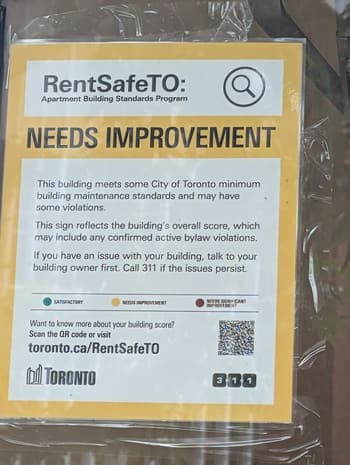
For Toronto landlords specifically, this provincial obligation sits alongside the City of Toronto’s own property standards requirements. A rental property in Toronto is subject to municipal property standards enforcement in addition to the RTA, and the City’s Multi-Tenant Housing and RentSafeTO programmes add further inspection and compliance obligations for buildings that fall within their scope. A landlord who is slow to address a pest report in Toronto may face action on more than one front.
Yellow 'NEEDS IMPROVEMENT' RentSafeTo sign on glass window
The single most expensive decision a landlord can make with a pest report is waiting to see whether the tenant is exaggerating.
Under Section 20 of Ontario’s Residential Tenancies Act, a landlord is responsible for maintaining a residential complex in a good state of repair and fit for habitation, and for complying with health, safety, housing and maintenance standards. Pest infestations fall within this obligation. The Landlord and Tenant Board has consistently treated infestations of cockroaches, bed bugs, mice, and other pests as maintenance issues that engage a landlord’s Section 20 duty.
Where legal responsibility sits
In most jurisdictions, including Ontario, pest control falls squarely within a landlord’s maintenance and habitability obligations. Rental units must be kept in a good state of repair and fit for habitation, and pest infestations are generally considered part of that standard. This applies regardless of how the infestation began.
That last point is important and frequently misunderstood. Even where a tenant’s behaviour contributed to a pest problem — poor sanitation, unreported issues, bringing in infested furniture — the landlord generally remains responsible for arranging and paying for the treatment in the first instance. What tenant conduct may affect is whether costs can be recovered afterward, and whether the tenant has breached their own obligations. It does not usually change the landlord’s duty to act promptly.
Attempting to shift the initial cost onto a tenant, or delaying treatment while a dispute about responsibility plays out, is one of the most common landlord mistakes. It rarely resolves the cost question and almost always makes the infestation worse.
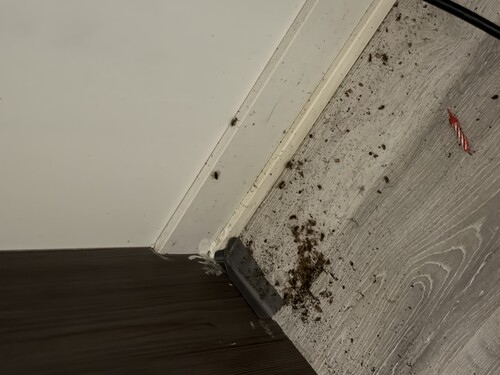
Cockroaches behind kitchen refridgerator
Landlord responsibilities under the RTA
Paying for professional extermination: Landlords are responsible for the cost of hiring licensed pest control professionals. This is a maintenance cost that sits with the landlord, not the tenant. Lease clauses that attempt to require tenants to pay for extermination or to arrange their own treatment are generally unenforceable — Section 4 of the RTA voids any provision in a tenancy agreement that is inconsistent with the Act. A clause purporting to transfer the landlord’s Section 20 maintenance obligation to a tenant will not typically survive scrutiny at the Landlord and Tenant Board.
Fixing entry points and structural conditions: The obligation extends beyond treatment to the structural conditions that permit pests to enter and persist. Sealing gaps and cracks, repairing or installing screens, fixing moisture problems, and addressing the physical defects that allow pests into the building are all part of a landlord’s repair obligation. Treatment without exclusion is not a durable fix, and a landlord who repeatedly treats without addressing entry points may find that the Board views the underlying maintenance issue as unresolved.
Acting promptly once notified: Landlords are expected to investigate and respond to pest complaints without unreasonable delay. The RTA does not prescribe a fixed number of days, but the Board assesses whether a landlord acted reasonably in the circumstances. Documented delay — particularly repeated delay, or a failure to respond to written complaints — is one of the most common bases for tenant applications regarding maintenance.
Treating the full scope of the problem: In a multi-unit Toronto building, treating a single reporting unit while leaving adjacent units untreated is frequently not an effective response. Cockroaches, bed bugs, and mice move through shared walls, plumbing chases, and electrical voids. A landlord whose treatment scope does not match the actual scope of the infestation may be found not to have discharged the Section 20 obligation, even though a treatment was technically performed.
Tenant responsibilities under the RTA
Tenants have genuine obligations that run alongside the landlord’s. Section 33 of the RTA requires tenants to keep the rental unit in a state of ordinary cleanliness, and Section 34 makes tenants responsible for repairing undue damage they or their guests cause. In the pest control context, the practical tenant obligations are:
Reporting pests immediately: Tenants are expected to notify the landlord promptly when they notice signs of pest activity. Delay allows infestations to grow and spread, and a tenant who conceals or significantly delays reporting may bear some responsibility for the resulting escalation.
Maintaining ordinary cleanliness: Tenants must keep the unit reasonably clean and avoid conditions that attract or sustain pests — accumulated garbage, food left out, or excessive clutter that prevents effective treatment. The standard is ordinary cleanliness, not perfection, and it is worth noting that pests infest meticulously clean units routinely.
Cooperating with treatment: This is the obligation most frequently at issue in practice. Tenants must complete the preparation the pest control company requires — laundering and bagging items, emptying cabinets, moving furniture away from walls, decluttering — and must allow the technician access on the scheduled date. Preparation is not optional; treatment effectiveness depends on it, and inadequate preparation is the most common reason a treatment fails and has to be repeated at additional cost.
Landlord vs Tenant Pest Control Responsibilities (RTA)
Provides proper notice before entering to treat (minimum 24 hours)
Does not obstruct or refuse treatment
Discloses known infestations before a tenancy begins
Provides available dates and allows access to perform follow-up visit or treatment
What to put in your lease as the landlord
A well-drafted lease does not shift the landlord’s legal obligations — that generally is not permitted — but it does clarify expectations and create a documented basis for cost recovery where tenant conduct is genuinely at fault. Consider including:
A prompt reporting clause: Requiring tenants to report suspected pest activity within a specified period of noticing it. Delayed reporting is the single biggest driver of infestation escalation, and a clause establishes the expectation clearly.
A cooperation and access clause: Setting out that tenants must prepare the unit per the pest control company’s instructions and allow access on scheduled treatment dates.
A secondhand furniture provision: Particularly relevant for bed bugs. A clause discouraging or prohibiting curbside furniture is not always enforceable but establishes the expectation and supports cost-recovery arguments.
A move-in and move-out inspection record: Documenting the pest-free condition of the unit at move-in protects both parties. It establishes a baseline and prevents disputes about whether an infestation predated the tenancy.
Have any lease clause reviewed against your local tenancy legislation. Clauses that attempt to transfer core landlord obligations to tenants are typically unenforceable and can undermine your position rather than strengthen it.
Managing cost across a portfolio
For landlords with multiple units or buildings, pest control shifts from a reactive expense to a manageable operating cost — if it is approached systematically.
Preventive service contracts: Scheduled quarterly or monthly service across a portfolio costs substantially less per unit than emergency call-outs, and catches problems at a stage where treatment is simple. For buildings with any history of cockroaches or mice, a maintained bait programme is the professional standard.
Turnover inspections: Inspecting a unit between tenancies, when it is empty and accessible, is the cheapest and most effective inspection you will ever conduct. It also prevents inheriting an infestation that the outgoing tenant never reported.
Exclusion work as a capital investment: Sealing entry points, installing door sweeps, repairing screens, and addressing structural gaps costs money once. Treating the rodent infestations that result from not doing it costs money repeatedly, forever. Exclusion is almost always the better financial decision over a multi-year holding period.
Building-wide treatment for shared-wall properties: In multi-unit buildings, treating units individually as complaints arrive is significantly more expensive over time than a coordinated building-wide treatment. Cockroaches and mice travel through shared walls, plumbing chases, and ductwork. Unit-by-unit treatment chases the problem around the building.
The infestations that cost landlords the most
Not all pest problems carry the same financial risk. Three in particular deserve disproportionate landlord attention:
Bed bugs: The most expensive and reputation damaging pest problem in rental housing. Treatment runs significantly higher than most other pests, spread between units is rapid, and tenant disputes are common. Early detection and immediate, thorough treatment across all affected and adjacent units is the only cost-effective approach. Partial treatment consistently fails.
Cockroaches in multi-unit buildings: German cockroaches travel between units through plumbing and electrical voids with ease. A single untreated unit can re-infest an entire floor. Buildings with recurring cockroach issues almost always have a unit that has not been treated, either because the tenant has not reported or has refused access.
Rodents with structural access: Mice and rats cause cumulative structural and electrical damage that is frequently not discovered until it is extensive. Chewed wiring is a fire risk with genuine liability implications. Rodent problems that are managed through trapping alone, without exclusion, become permanent operating costs.
Portfolio pest management for GTA landlords
Guard More Pest Control works with landlords and property managers across the Greater Toronto Area on both reactive treatment and scheduled preventive programmes. For multi-unit buildings, coordinated building-wide treatment and exclusion work is consistently more cost-effective than unit-by-unit response. Email us at contact@guardmorepests.com to discuss a portfolio pest control assessment.
If you find our content useful, please add guardmorepests.com as a preferred source on Google.
Keep Your Home/Business Pest-Free Today
Do you have a pest problem that needs to be looked at right away? Contact Guard More Pest Control about your pests and we'll work on solving your pest problem within 24 hours.
.png)