Rat Control Case Study: Semi-Detached House Basement Wall Infestation in Toronto
Last updated:
November 4, 2026
Case snapshot
Rats had moved into the insulated wall built against the front half of a basement's cement foundation, running and nesting through the insulation out of sight. Guard More Pest Control traced their activity to a single chewed hole on the porch under the wooden connecting wall between both semi-detach homes leading into the affected home's foundation.
Bait stations installed around interior basement parameter
Prior result
Rat activity increased in affected area
Our treatment
Inspection of the wall cavity and foundation, exclusion of entry point
Where rats were found
Inside the insulation of the framed wall addition covering the front of the house's cement foundation wall
Service date
October 29, 2026
Technician
Jason Chan (License #: L-206-1475007783)
The problem
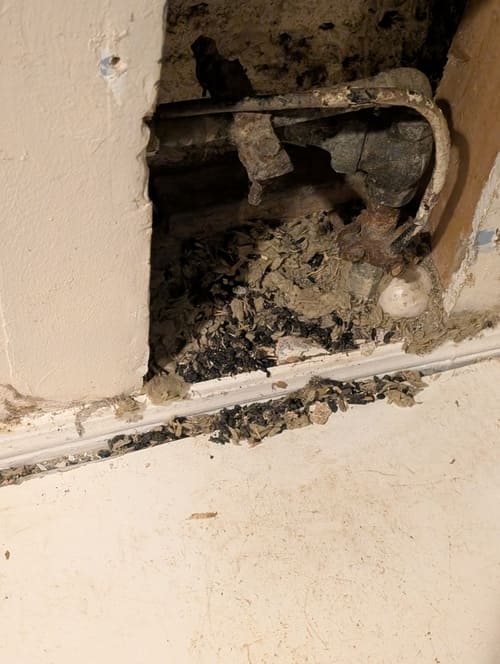
The client was dealing with a significant rat infestation in the basement. Rats were running through the wall addition built in front of the cement foundation wall and contaminating the insulation as they scurried across the front half of the basement. The client opened up the water metre panel to show rat feces in the disturbed insulation.
Rat feces in chewed wall insulation near water metre
Why rats move into insulated basement walls
A framed wall built in front of a foundation creates a hidden cavity that gives rats everything they need: shelter, nesting material, and a protected route through the basement.
The cavity is out of sight. The space between the foundation and the new wall can't be seen from the room, so rats can travel and nest there for weeks before anyone notices.
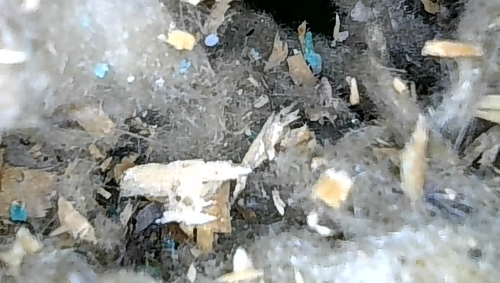
Insulation becomes nesting material. Rats shred and tunnel through wall insulation to build nests, which also ruins its ability to insulate.
Foundations give them a way in. Norway rats burrow along foundations and get in through cracks, gaps around pipes and utility lines, and openings around windows. A gap about the size of a quarter is enough for a young rat.
Traps in the room miss them. Traps and bait placed on the basement floor don't reach rats that stay inside the wall, so activity keeps going while the room looks clear.
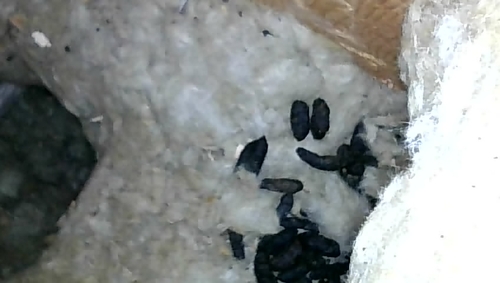
Rats in a wall cavity are more than a noise problem. They contaminate insulation with urine and droppings, gnaw on wiring, and break vapour barriers.
Rats nest in wall insulation
Rat feces in wall insulation
Our rodent control treatment
We treated the rats where they were living, inside the wall, and then closed off the way in so new rats can't replace them.
Inspect first. Open inspection points in the wall addition and check the insulation, the base of the wall, the sill plate and the outside of the foundation to find runways, nests and entry points.
Trapping inside the activity zone. Set traps along the runways inside and at the base of the wall, where the rats were actually travelling. We use large snap traps to kill the rats.
Exterior control. We install medium sized bait stations containing CONTRAC BLOX PCP Reg. No. 22239 around the exterior parameter and 1-2 stations around the affected foundation wall addition.
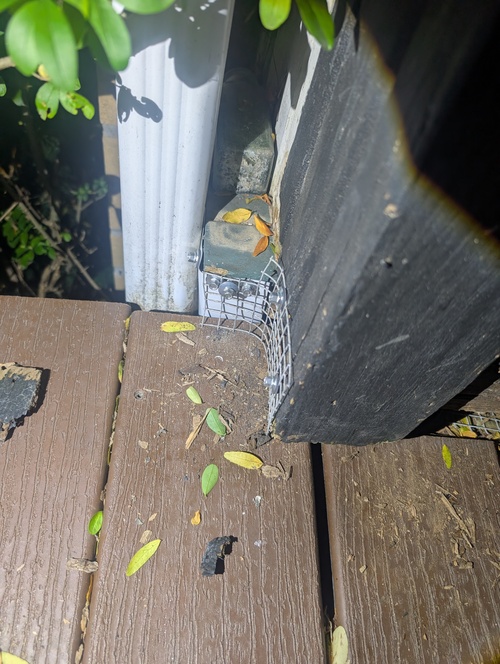
Exclusion. Seal the entry points with rodent-proof materials such as steel mesh, hardware cloth, metal flashing or concrete patching. We used 24 gauge steel flashing and steel mesh to seal the hole under the wooden porch wall.
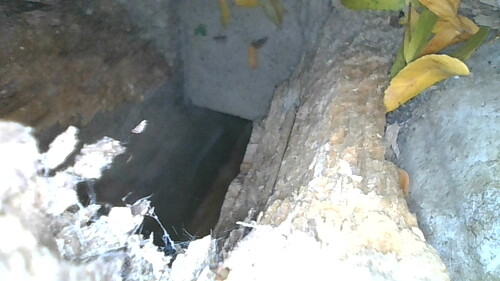
Exposed hole in joint wooden porch wall
The hole above provide entry into the house's foundation wall
Steel flashing and mesh installed to cover rodent chewed wooden porch hole
Results
Update on treatment results to be provided in 2-3 months.
Key takeaways
For homeowners
Scratching or running sounds in a basement wall usually mean rats are inside the cavity, not just passing through the room.
Traps on the basement floor won't solve a problem that lives inside the wall.
Removing the rats without sealing the entry point means new rats can move in.
For landlords and property managers
Finished basements with framed walls against the foundation need an inspection of the cavity, not just the room.
Rats in wall insulation damage the insulation and can chew wiring, so fixing it early costs less.
Exclusion work on the foundation protects every unit in the building, not just the one with the complaint.
If you find our content useful, please add guardmorepests.com as a preferred source on Google.
Keep Your Home/Business Pest-Free Today
Do you have a pest problem that needs to be looked at right away? Contact Guard More Pest Control about your pests and we'll work on solving your pest problem within 24 hours.