.png)

What Is the Difference between Wasps and Hornets?
Last updated:
July 26, 2026

Ask most Ontario homeowners what stinging insect is nesting under their eaves and they may commonly answer with 'wasps' and the occasional 'hornets'. Ask a pest control technician, we will answer with lecture about how wasp and hornet are not the same thing. There are difference between them determines how dangerous the nest is, how large it will grow, and what it takes to treat it safely.
This guide covers every stinging insect species found in Ontario homes and yards, what separates wasps from hornets, how to identify which one you're dealing with, and exactly what that identification means for the treatment approach.
The word 'hornet' is commonly used as a catch-all for any large, aggressive stinging insect. Actually it's all hornets are wasps (Vespidae family) but not all wasps are hornets. Hornets are a subgroup within the broader wasp category, distinguished by their larger body size, different nesting behaviour, and significantly greater colony aggression.
In practical terms for Ontario homeowners:
Bald-faced hornets are technically classified by entomologists as a Yellowjacket species rather than a true hornet. In pest control practice, they are treated as hornets because their size, nest type, and aggression profile match the hornet category far more closely than a Yellowjacket.
Yellowjackets (Vespula germanica and Vespula vulgaris) are the species behind the vast majority of serious stinging incidents in Ontario. They are highly aggressive social wasps that defend their territory actively — not just when the nest is disturbed, but when they perceive any threat in a radius of several metres.
Yellowjackets build papery nests from chewed wood fibre mixed with saliva. They nest in three primary locations in GTA homes and yards:
Underground and wall void nests are the most dangerous because the colony is completely enclosed and the entrance is often not visible until it is stepped on or disturbed.
A Yellowjacket colony at peak season (late August and September) can contain 3,000 to 15,000 workers. Individual workers can sting multiple times without dying. When a colony is disturbed, the alarm pheromone released by the first few stings triggers a rapid mass mobilisation of the worker population with hundreds of workers responding within seconds. People who accidentally step on or near an underground nest have reported receiving dozens of stings before they were able to move away.
Late summer aggression increases significantly as food sources diminish and the colony concentrates on nest defence. A Yellowjacket nest that was relatively unobtrusive in June becomes a genuine safety hazard by August.
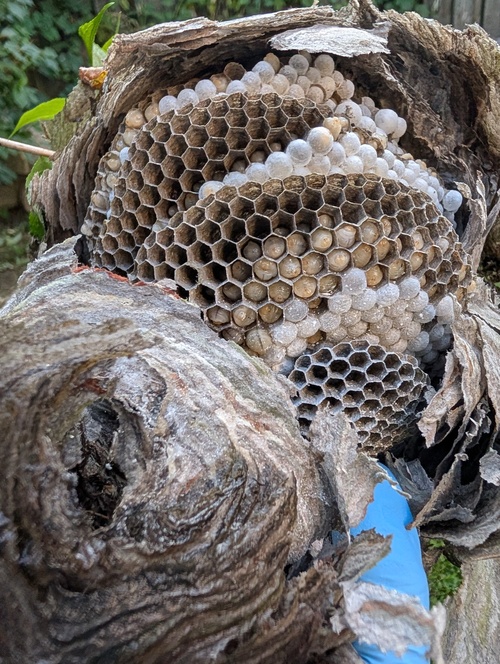
The Bald-Faced Hornet (Dolichovespula maculata) is the most visually distinctive stinging insect in Ontario. It is large, black-and-white, and capable of building football-to-basketball-sized aerial nests in trees, on building exteriors, and under deck structures.
Bald-Faced Hornets build large enclosed papery nests attached to tree branches, building eaves, fence posts, and the underside of decks. Nests begin golf-ball size in May and grow to football or basketball size by August which can contain between 400 to 700 workers at peak. Unlike Yellowjacket aerial nests, bald-faced hornet nests are always fully enclosed with a small entrance hole at the bottom.
Why they require professional treatment:
Bald-Faced Hornets are among the most aggressive stinging insects in North America when their nest is approached. Their defence radius extends several metres. People have been stung simply walking too close to a nest without touching it or the branch it's on. This defence radius makes DIY treatment genuinely dangerous: by the time you are close enough to apply a consumer spray, you are already within the zone where workers will respond.
The European hornet (Vespa crabro) is Ontario's only true hornet by strict entomological definition, it is the largest stinging insect spanning 25 to 35 mm that most GTA homeowners will ever encounter.
European hornets nest in enclosed cavities: tree hollows, wall voids, attic spaces, and old outbuildings. Unlike Yellowjackets, they rarely nest underground. The nest itself is made of the same papery material as Yellowjackets and bald-faced hornets, but is typically found inside a cavity rather than exposed in the open. Mature European Hornet colonies contain 200 to 400 workers.
European hornets are less likely to sting unprovoked than Yellowjackets, but they are still capable of multiple stings and will defend the nest aggressively if it is disturbed. Their large size makes individual stings more physically impactful than those of smaller species. Wall void nests in particular should not be treated without professional equipment.
Paper wasps (Polistes fuscatus and related species) are the most frequently encountered stinging insect on GTA residential properties. They build the characteristic open-comb umbrella-shaped nests that most homeowners recognise on their eaves, under deck boards, and on fence posts.
Paper wasps are significantly less aggressive than Yellowjackets or bald-faced hornets. A small early-season nest under 30 workers found in spring can generally be knocked down at night with a consumer aerosol spray with acceptable risk. The caveat: by August, a large established paper wasp colony under a frequently used eave or deck board can produce a painful defensive response when the nest is accidentally disturbed during normal property use. A colony found in high-traffic proximity should be treated professionally.
Mud daubers (Sceliphron caementarium) are solitary wasps that build distinctive clay or mud tube structures on walls, under overhangs, and inside garages and sheds. They are not a stinging threat because mud daubers are non-aggressive, do not have a colony to defend, and essentially never sting humans unless physically handled. The mud tubes are harmless and can be removed by hand.
If you have mud tubes on your exterior walls, the correct action is physical removal of the dried mud, not pesticide treatment. If mud daubers are a recurring issue, homeowners should seal gaps in siding and garage doors eliminates the sheltered surfaces they prefer for nest-building.
When you see a stinging insect or a nest, these six questions identify the species within seconds:
Do you have a pest problem that needs to be looked at right away? Contact Guard More Pest Control about your pests and we'll work on solving your pest problem within 24 hours.