.png)

How Termites Get Into Concrete Foundation Cracks
Why a hairline crack in your basement slab is an open door and what you should look for before the damage is structural
Last updated:
October 3, 2026

Why a hairline crack in your basement slab is an open door and what you should look for before the damage is structural
There is a widespread and costly assumption among homeowners that a concrete foundation is a termite barrier. It is an understandable belief. Concrete is hard, termites eat wood, and the two do not seem related. But the species of termite found in Ontario does not need to eat through concrete to get past it. It only needs to find a gap.
Eastern subterranean termites, the species present in Toronto and across southern Ontario, live in colonies in the soil beneath and around a building. Their entire foraging strategy is built around finding routes from that soil into the wood above. A concrete foundation is not an obstacle to them — it is a surface with cracks, joints, and penetrations in it, and they are extremely good at finding them.
Subterranean termites can pass through a gap as narrow as 1.6mm which is roughly the thickness of a credit card. A hairline crack in a basement slab that you would never think to repair is a fully viable entry point.
This is the key thing to understand. Termites cannot chew through sound concrete, and they do not try. What they do is exploit the openings that already exist in every concrete foundation, because no concrete foundation is monolithic and crack-free over its lifetime.
Concrete cracks for entirely normal reasons: shrinkage as it cures, settlement as the building loads the soil beneath it, thermal expansion and contraction, and in the GTA specifically, the freeze-thaw cycling that repeatedly expands and contracts both the concrete and the soil around it. Every one of these processes produces openings. Most are cosmetically insignificant and structurally irrelevant. To a foraging termite, they are routes.
Subterranean termites also actively widen existing openings. They cannot damage the concrete itself, but they can and do remove the soil, mortar, and debris packed into a crack, gradually opening a passage that was previously too tight to pass through.
Termite inspectors look at a foundation differently than homeowners do. These are the locations that matter:
Hairline cracks in a basement floor slab are extremely common and almost always structurally harmless. They are also the most frequently used termite entry route into Ontario homes. A crack that runs from the slab edge inward provides a direct path from the soil below to the interior of the basement, and from there to any wood in contact with the floor.
Where a basement floor slab meets the foundation wall, the two were poured at different times and do not bond. This creates a continuous gap around the entire perimeter of the basement, usually concealed beneath finished flooring or behind framing. It is one of the most reliable termite entry routes in residential construction and one of the hardest for a homeowner to inspect.
Deliberately formed joints in a slab or driveway, designed to control where cracking occurs. They work as intended structurally, but they also create a planned, continuous gap through the full depth of the concrete. Joints filled with deteriorated or missing sealant are direct access points.
Every pipe, conduit, and service line that passes through the foundation creates an opening. The gap between the pipe and the concrete is frequently unsealed or sealed with material that has degraded. Floor drains, sump pits, water service entries, and gas line penetrations are all common entry points, and because they are often behind or beneath fixtures, they are rarely inspected.
Concrete block foundations contain continuous vertical voids. If the top course is not capped or filled, termites entering a crack anywhere in the wall can travel upward through the hollow cores entirely concealed, emerging directly at the sill plate with no visible evidence on the exterior of the wall.
Concrete porches, stoops, and steps poured against the foundation frequently contain fill soil or voids underneath. This creates a protected, moist, soil-filled space directly against the building — ideal termite habitat with direct access to the structure, and completely invisible from outside.
Subterranean termites have soft bodies that dry out rapidly when exposed to air. They cannot survive crossing an open surface. To travel across concrete — up a foundation wall, across a slab, over a pier — they build enclosed tunnels out of soil, saliva, and faecal material. These are mud tubes, and they are the most reliable visible evidence of subterranean termite activity.
What to look for:
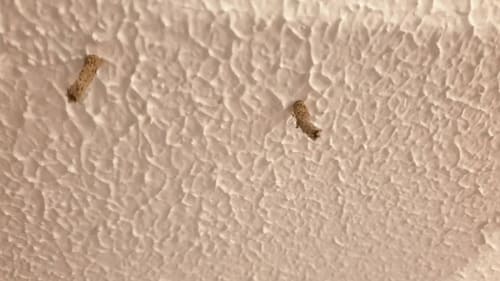
Carpenter ants are far more common in the GTA than termites, and the two are frequently confused. The distinction matters because the treatment approaches are completely different.
The clearest practical distinction is this: if you find a pile of sawdust-like material beneath damaged wood, you are almost certainly dealing with carpenter ants. Termites do not produce sawdust — they consume the wood entirely and pack their galleries with soil. If you find mud tubes, you are dealing with subterranean termites. Learn more about the differences between carpenter ants and termites.
Termites are not evenly distributed across Ontario. They exist in established, localised pockets, and Toronto contains several of them. Parts of the East End, the Danforth, and areas of North York and Scarborough have documented termite activity going back decades. The City of Toronto has operated termite control and monitoring programmes in response.
Several factors make GTA housing stock vulnerable:
If you are purchasing a property in a neighbourhood with known termite activity, a dedicated termite inspection is worth commissioning separately from a general home inspection. Standard home inspections are not termite inspections, and inspectors are not typically required to move stored items, lift flooring, or probe concealed framing. Existing termite damage is one of the few property defects that can be both severe and genuinely invisible at the time of purchase.
There are meaningful homeowner-level prevention measures, and there are clear limits to them.
What is genuinely worth doing:
What homeowner measures cannot do:
Crack sealing and moisture management reduce risk. They do not eliminate an existing colony, and they do not address the entry routes you cannot see — the slab-to-wall cold joint, the voids beneath a porch, the interior of a block foundation wall. A subterranean termite colony lives in the soil and may extend many metres from the building. Surface treatment of a foundation does not reach it.
Sealing visible foundation cracks and expansion joints is worth doing as a preventative measure, and is best handled by a qualified concrete repair or foundation contractor. Proper repair requires filling the crack through its full depth with a flexible sealant rated for the movement Toronto's freeze-thaw cycle produces while surface patching typically fails within a season and conceals the crack from future inspection without actually closing it. Keep in mind that crack repair is prevention, not treatment: it closes the routes you can find, but it does not eliminate a colony already established in the soil, and it does not address the entry points you cannot see.
Professional termite management for subterranean species typically involves either a continuous treated soil barrier around the foundation perimeter, or a monitoring and baiting system installed in the soil that colony members carry back to the nest. Both approaches target the colony rather than the individual termites entering the building, and both require licensed application. In Ontario, anyone applying pesticides commercially must hold a valid exterminator licence from the Ministry of the Environment, Conservation and Parks.
Book a professional termite inspection if any of the following apply:
Termite damage accumulates slowly and silently. A colony can be active in a structure for years before the damage becomes visible, and by the point that doors begin sticking or a floor feels soft, the remediation required is substantially greater than it would have been at detection. The cost difference between early detection and late discovery is the single largest variable in termite management.
Do you have a pest problem that needs to be looked at right away? Contact Guard More Pest Control about your pests and we'll work on solving your pest problem within 24 hours.